Friday, February 23, 2018

My Visual Travel Experience: Tokyo

I finally made it to Tokyo for the first time ever this year in January. It was always very high on my list, but I had somehow never managed to visit. My father had spent 3 years in Tokyo in the late 1950s; he learned Japanese as his foreign language when he joined the Indian Foreign Service, and Tokyo was his first ever posting as a diplomat. He used to often talk about his time in Tokyo, so I was really looking forward to my visit, though it was with a tinge of sadness, because I didn't make it there in his lifetime!

Tokyo has a population of almost 9 million; it goes up to over 13 million if one takes Tokyo Prefecture; if one takes Greater Tokyo (which includes suburbs like Yokohama and Kawasaki), the population is a staggering 37 million, making it the largest urban agglomeration in the world! Tokyo, earlier called Edo, has been the capital of Japan since 1868, when Emperor Meiji shifted the capital from Kyoto. It's quite amazing how tradition, history and the glitzy modern world all co-exist beautifully in this city.

I had hear about Tokyo being one of the world's most expensive cities. I was pleasantly surprised to note that that was not my experience at all. Sure, if one wants to spend money by staying in fancy hotels, eating at fine dining restaurants, and travelling everywhere by taxi, then Tokyo can be very expensive. But if one is a little careful, Tokyo is unbelievably reasonable. It's about 110 JPY to 1 US Dollar. My daily spends, barring my hotel stay, came to barely 5,000 JPY, and that included my lunch and dinner (my average meal cost me not more than 1,000 JPY), travelling to every nook and corner of the city by metro, and a lot of sightseeing (most museums, shrines and other places of interest had entrance fees of barely 500 JPY). My hotel, which was a fairly comfortable three star property not far  from the heart of the city, cost me around 8,000 JPY a night, including breakfast, so that was pretty reasonable too.

For a traveler, Tokyo has a lot to offer. I'd be out of my hotel by around 8 am, and I'd be back by around 6 pm, having packed in 4 or 5 sites every day. I ended up walking over 20 km a day, but that does happen when one is going everywhere by public transport. It was winter, with temperature ranging between 5 and 10 degrees Celsius, so after being clad properly, walking so much was hardly a problem (it's that much tougher in summer when one tends to sweat like crazy).
Panoramic view of Tokyo, with Mount Fuji
in the background, as seen from Tokyo Skytree
Senso-ji Temple is Tokyo's best known temple. The temple's origins date back to the 7th century AD. One enters from the Kaminarimon Gate and walks through Nakamise-Dori, a 250 meter long street with traditional shops on both sides. Besides the Main Hall with the main deity, the temple also has a large 5 story pagoda.
Senso-ji Temple, with its 5 story pagoda
Hozoman Gate, Senso-ji Temple
Kaminarimon Gate, Senso-ji Temple
Main Hall, Senso-ji Temple
Nade Botokesan Buddha, Senso-ji Temple
Meiji Shrine lies in the middle of a large forested area, and is dedicated to Emperor Meiji and Empress Shoken. The emperor died in 1912, and was one of the most popular emperors in the country's history. To get to the main shrine, one has to walk a lot through the forested area, and one also walks through a few large gateways.
Meiji Shrine
First Gateway, Meiji Shrine
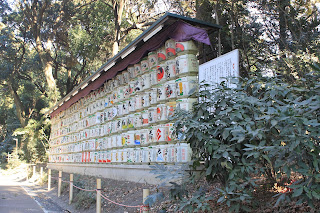
Sakes, Meiji Shrine
Yasukuni Shrine is a Shinto shrine established by Emperor Meiji in 1869. It commemorates Japanese soldiers who died in various wars. The complex has an interesting war museum, and lists details of over 2 million people killed in battle.
Omura Masujiro statue at
Yasukuni Shrine
The Imperial Palace is the residence of the Emperor of Japan. The complex lies within large gardens, and includes the main palace, the royal residences, an archive, museums and offices. Edo Castle was previously situated at this site. 
The Imperial Palace seen from Nijubashi Bridge
The National Diet Building is where the Japanese parliament sits. The building was completed in 1938. The central tower , with its pyramid shaped dome, is 65 meters high, and at the time of its construction, it was the tallest building in Tokyo.
National Diet Building
Tokyo Skytree is a transmission and observation tower. It was completed in 2012. and at a height of 634 meters, it became the world's second tallest structure, after Dubai's Burj Khalifa, which has a height of 829 meters. Tokyo Skytree offers great views of Tokyo, and on clear days, Mount Fuji (which is 100 km away) is also visible.
Tokyo Skytree
Tokyo Tower was built in 1958. It has a height of 333 meters and is orange and white in colour. It was inspired by Paris' Eiffel Tower, and is even taller than it. Though much shorter than Tokyo Skytree, Tokyo Tower also has splendid views of the city.
Tokyo Tower
Shinjuku is a large commercial district. Shinjuku East is known for its red light district, entertainment zones and bars. Shinjuku West boasts of skyscrapers like the Tokyo Metropolitan Government Building, the Monolith Building and the Sonpo Japan Building. Another famous district in Tokyo is Shibuya, a shopping and commercial district surrounding Shibuya Station. It’s a popular hang-out district with the youth, and is full of shops and restaurants catering to them.
Sonpo Japan Building, Shinjuku West
Sculpture at Tokyo Metropolitan Assembly, Shinjuku West
Tokyo Metropolitan Assembly, Shinjuku West
Ginza is an upmarket shopping district in the heart of Tokyo, and is known for its department stores, and its luxury shops. Highlights at Ginza include Mitsukoshi Department Store, Wako Department Store with its distinctive clock-tower, Kabuki-za Theatre, and stores of high end brands like Louis Vuitton, Chanel and Dior.
Kabuki-za Theatre at Ginza
Wako Department Store at Ginza
San'ai Building at Ginza
Ueno Park is a large urban park that opened in 1873.  The park has several prominent museums including Tokyo National Museum, National Museum of Western Art and National Museum of Nature and Science. It also features Ueno Zoo, Japan’s oldest zoo which opened in 1882. 
Saigo Takamori Statue, Ueno Park
Pagoda, Ueno Zoo

Polar Bear, Ueno Zoo
Tiger, Ueno Zoo
Tokyo National Museum was established in 1882. The complex consists of the Honkan Gallery (the Japanese Gallery), the  Toyokan Gallery (the Asian Gallery) and the Heiseikan Gallery (which boasts of a fine collection of archaeological finds). The museum has over 110,000 objects, and is one of the largest art museums in the world.
Head of a Man at the Honkan Gallery,
Tokyo National Museum
Buddha Triad from China at the Toyokan Gallery,
Tokyo National Museum
Terracotta Horse at the Heiseikan Gallery,
Tokyo National Museum
Korean Daggers at the Toyokan Gallery,
Tokyo National Museum
Papier Mache Dog at the Honkan Gallery,
Tokyo National Museum
Glazed Camel at the Toyokan Gallery,
Tokyo National Museum
National Museum of Western Art has an impressive collection of European paintings and sculptures by artists like Rubens, Monet, Rodin, Cezanne and Picasso. The museum was set up in 1959, and primarily has the private collection  of Matsukata Kojiro (1865-1960). The building was designed by the famous French architect Le Corbusier. It has by far the most amazing collection of European art that I have seen outside Europe and the US.
Renoir's Reclining Bather, 
National Museum of Western Art
Monet's Peony Garden, 
National Museum of Western Art
Rubens' Two Sleeping Children, 
National Museum of Western Art
Rodin's The Thinker, 
National Museum of Western Art
Monet's Water Lillies,
National Museum of Western Art
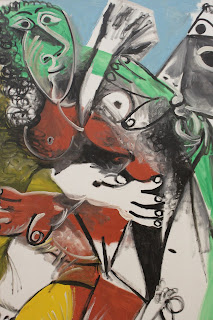
Picasso's Couple,
National Museum of Western Art
Segantini's The Sheepshearing,
National Museum of Western Art
Sisley's The Port of St Tropez,
National Museum of Western Art
The National Museum of Nature and Science has an impressive collection of dinosaur skeletons, stuffed animals, models of ancient man, minerals, telescopes, clocks and scientific equipment.
Dinosaur skeleton at National Museum of Nature and Science
Exhibit on Dogs at National Museum of Nature and Science
Tokyo International Forum is a multi purpose exhibition centre.  The steel and glass structure was completed in 1996. It has an exhibition hall, restaurants, shops. The building is shaped like an elongated boat.
Tokyo International Forum
Royal Costume, Tokyo International Forum
Madame Tussauds lies in Odaiba, across the Rainbow Bridge. It is inside Decks Mall along the waterfront, and has wax figures of Japanese and international celebrities. It is one of some 2 dozen Madame Tussauds museums that have now sprung up across the world.
Wax sculpture of former Japanese Prime
Minister, Junichiro Koizumi, at Madame Tussauds
Wax sculptures of Madonna 
at Madame Tussauds
Michael Jackson at Madame Tussauds
There is a Statue of Liberty replica at Odaiba, close to the Rainbow Bridge, and near the Decks Mall that houses Madame Tussauds. It is a symbol of Japanese - American friendship.
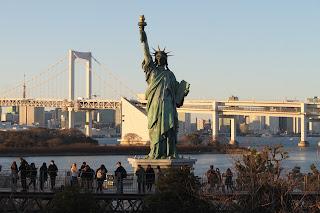
Statue of Liberty replica
Tokyo Station is the city's main railway station, with trains going all over Japan from there. Japan is famous for its Shinkansen Bullet Trains, that touch speeds of close to 300 kmph, are known for their efficiency and precision, and are a life-line in the country.
Tokyo Station
Shinkansen, Tokyo Station
Mount Fuji lies 100 km south west of Tokyo, and on clear days, can be seen from places like Tokyo Skytree and Tokyo Tower. The peak is Japan’s highest and stands at a height of 3,776 meters. It is an active volcano that last erupted in 1708. I went on a full day's guided bus tour to Mount Fuji, and the tour included visits to several places at the base of the peak - Oshino Eight Ponds (where melted snow from the peak trickles and settles down over a period of many years), the Japanese Garden at Oshino Ninja Village, Fujiyama Amusement Park (with its spectacular 4D virtual reality experience of flying over Mount Fuji) and Lake Kawagachiko. It was an awesome day, but the dampener was that it was cloudy, and I couldn't get a very clear view of the peak.
Mount Fuji
Japanese cuisines are famous all over the world. The best known Japanese cuisines are probably Sushi (usually cold seafood) and Ramen (hot soup with noodles and meat). Both are widely available and are popular with locals and tourists.
Ramen with Fried Chicken, a local speciality
All in all, Tokyo was an amazing experience. I managed 5 action packed days between Tokyo and Mount Fuji, and managed to cover the main highlights. I missed out on the world famous Tsukiji Fish Market (the world's largest fish market) because it was shut the day I visited. If I had another day, I would have also visited Tokyo Disneyland, but I only had so much time. The friendliness and politeness levels of the Japanese people were simply amazing. I was also awestruck by the overall efficiency and precision levels everywhere, and nowhere was this more true than in the amazing Shinkansen bullet trains (which I experienced on my trip to Kyoto), where a time of 9:18 means 9:18 and not even 9:18 and 30 seconds! Quite a contrast from the Indian Standard Time that I normally see around me, where 5 minutes can range from 5 minutes to half an hour!!

Friday, February 2, 2018

Partition: My Family's Experiences

Every family that lived through the days of partition in 1947 has a story to tell. Here’s the story of my family, as told to me over the years by my mother. Every time I've heard the story, some new nugget or the other has come out, and I've been quite spellbound and have been transported to another era. It all seems so unreal and distant, and yet it was in the living memory of my mother.

My mother, Oonita, was just 12 when partition took place. She lived in Bahawalpur with her father Ram Narain Kathpalia, mother Kaushalya Kathpalia, paternal grandmother, two elder brothers Jagat and Pearey (aged 23 and 21 respectively) and elder sister Indira (aged 16). My grandfather used to work as an engineer for the Nawab of Bahawalpur, and was close to him. The Nawab was a secular man, and it didn’t matter to him that my grandfather was a Hindu in a largely Muslim state.

Communal violence was initially not rampant in Bahawalpur, but gradually the atmosphere worsened. My grandmother’s father was killed in a violent attack, and that shook the family and made them realize that staying on in Pakistan was not really an option. My grandfather used to travel often on work, and during one such travel, he put a trusted Muslim friend in charge to take care of the family. Both my Uncles were studying in college back then – the elder one in Lahore, and the younger one in Amritsar - so it was only my great grandmother, my grandmother, my aunt and my mother who were at home. This avuncular Muslim gentleman guarded them closely, with his gun in hand. One day, he had to be away. He called my aunt, handed over his gun to her and said “If there is an attack on the household, you must protect the honour and dignity of all the women of the household. You must first shoot your grandmother, then your mother, then your sister, and then yourself.” Saying this, he taught her how to use the gun. While showing off her newly acquired talent to my mother, my aunt accidently fired the gun. The bullet almost scraped my mother’s forehead, but luckily she had a narrow escape by a hair’s breadth! Both sisters were very worried about what to say to my grandfather because the bullet lodged itself into the expensive wooden bookshelf in his study!
That dreaded confrontation with my grandfather never happened, because just days later, in November 1947, my grandfather returned from tour and announced that it was time to leave Pakistan and move to India. The family decided to relocate to Delhi. People leaving for India were being attacked by mobs, so the operation had to be done discretely. The Nawab was a life saver. In his personal train, he sent off the entire family, on the pretext of sending my grandfather for an important project. To avoid raising suspicion, all belongings were left in the house. Everyone took just one suitcase full of their bare essentials. The Nawab’s train took my grandparents, my great grandmother, my aunt and my mother to Abohar Mandi in Punjab, and from there, they made their way to Delhi.

In Delhi, the family led a nomadic existence for a few months. My younger uncle, Pearey, had come to Delhi from Amritsar earlier itself. As a medical student, he had come to Delhi to help riot victims. He heard that the family may be on a train carrying refugees from Bahawalpur, so he went to the railway station and was able to meet the rest of the family. Pearey was staying with a friend (his future wife Kanti’s elder brother, who was an army officer) at 8 Tolstoy Marg. This friend had got this house from a Muslim family, with whom he had done an exchange for a house in Lahore. The family stayed there for about 2 weeks. Since my grandfather was an employee of the Nawab of Bahawalpur, he was then allowed to move the family to Bahawalpur House on Bhagwandass Road, where they all stayed at the manager’s house for 2 months.
Yogi Bhai was a friend of my grandfather’s, and he too had managed to stay at Bahawalpur House in those early days after partition. His family had moved into an empty house vacated by a Muslim family on GB Road. My mother and aunt moved into that house with his family and lived there for the next few months. The family was kind to them, but the girls had to do all the household chores to help out. Yogi Bhai got my mother admission into Queen Mary’s School. It was an English medium school. My mother initially had her hands full, because she had been home educated, and that too, in Urdu. Back in Bahawalpur, there were no schools for girls in those days. English was tough for her given her entire education had been in Urdu (though my grandfather was highly anglicized and was referred to as a “Brown Englishman”). Hindi was even tougher. My mother was persistent though, and ironically, a few years later, her English had improved so much (through avid reading in the school’s library – she diligently completed 2 books every week) that she went on to do her BA and later her MA in English from Miranda House in Delhi University. She also became a member of the Shakespeare Society in Delhi University and acted in several Shakespeare plays! My aunt Indira meanwhile went to Indraprastha College in Delhi University for her graduation.

My elder uncle, Jagat, was away studying in Lahore and in the atmosphere that prevailed, there was no way to get in touch with him or even tell him that the whole family was in Delhi. Connaught Place was the meeting point for everyone those days. Every day, my mother and aunt would go to Connaught Place looking for my uncle, hoping that one day he would magically land up there. Months passed by, but there was no news of my uncle. Then about 3 months later, one day my mother and aunt were travelling in a rickshaw when my mother suddenly said “Stop stop stop. That looks like Jagat Bhai”. Sure enough, that was my uncle. He had guessed correctly that the family must have moved to Delhi, and he also found his way there. Like everyone else, he would also go to Connaught Place in a desperate attempt to try and find the family or at least a familiar face who would have news about the family. So finally, the entire family was reunited.
Sadly, the joy was short-lived, because my uncle Jagat died of TB a few months later at the young age of 24. When he was ailing, he moved to Dharamshala with my grandparents, while my mother and aunt were staying with Yogi Bhai’s family. Those days, the only cure for TB was to send patients away from a big city, where there was cleaner air and less pollution. Unfortunately, that wasn’t enough and my uncle passed away on 15th August, 1948, the 1st anniversary of India’s independence.

My grandfather was soon back on his feet to support the family. He moved to Yamunanagar and later to Rajpura, and was involved in building refugee colonies in both towns. He was able to rebound from the ordeal of partition and from losing his first born child, and he was able to take care of the family and ensure that all his surviving children got well educated and did well for themselves.
The three siblings went on to make Delhi their permanent base. My younger uncle became an army doctor, my aunt married an IAS officer, and my mother married an IFS officer, so they all spent years away from Delhi in different places, but Delhi was always home for them, and it continues to be home for me and my sisters! After all, Delhi was the city that opened up its arms to my ancestors when they were homeless refugees!
A Family Photo from 1942: My Aunt (Indira Kathpalia),
My Elder Uncle (Jagat Kathpalia),
My Uncle (Pearey Kathpalia),
My Mother (Oonita Kathpalia),
My Grandfather (Ram Narain Kathpalia) and 

My Grandmother (Kaushalya Kathpalia)

Friday, August 4, 2017

My Visual Travel Experience: Prague

Prague, the capital of the Czech Republic and a city with a population of over 1.2 million, is one of the prettiest cities in Europe. I went there on a school trip as a kid in the mid eighties, and then I went and spent three days there in 2008. I was totally taken in by the beauty of the medieval old town square, and all the landmarks that are dotted along it.
Old Town Square with the Old Town Hall
Prague became one of Europe's most important capital cities in the 14th century under the rule of the Holy Roman Emperor, Charles IV, who was the king of Bohemia. The city prospered under him and saw a lot of development. In the 16th century, Prague came under the rule of the Austrian Habsburg empire and became one of its most important centres. The end of World War I saw the death of the Habsburg empire and Czechoslovakia was formed, with Prague as its capital. In 1993, Czechoslovakia split up into the Czech Republic and Slovakia, and Prague became the capital of the Czech Republic.

The Old Town Square lies in the heart of the city, and has several of the city's best known landmarks around it. It also has numerous high end shops, restaurants and cafes. In the centre of the square, there's the Jan Huus Monument, erected in 1915 to commemorate the 500th anniversary of his burning at the stake. He was a rebel leader who fought against the corrupt practices of the Catholic State. The Old Town Hall was built in the 14th century. It is 69 meters tall and has a viewing gallery at the top. The building has an astronomical clock with mechanical figures that perform with a set frequency. The Church of Our Lady of Tynn has two distinct spires. The church dates back to the 14th century and became a Jesuit church in the 17th century. It has a rich, baroque interior. Kinsky Palace on Old Town Square was built in 1765. It was built by the Golz family and then bought by the Kinsky noble family, and hence the name. It is now an art museum. I found myself spending almost a full day at the Old Town Square, between seeing the various sights, having a leisurely lunch sitting at one of the many outdoor cafes, and window shopping at the fancy shops around.
Jan Huus Monument
Church of Our Lady of Tynn
Church of Our Lady of Tynn,
View from Old Town Hall
Old Town Hall
Kinsky Palace, Old Town Square
The Old Town Square also boasts of the Church of St Nicholas, which has a large green dome and two bell towers. It also has a large chandelier inside. The church was completed in 1737.
Church of St Nicholas, Old Town
Church of St Nicholas,
View from Old Town Hall
Church of St Nicholas, Old Town
Powder Tower is one of the original city gates dating back to the 15th century. It separates the Old Town and the New Town. In the 17th century, the tower was used to store gunpowder, and hence the name.
Powder Tower
There is also the Church of St Nicholas in the Lesser Town, completed in 1755. It is a richly decorated baroque church, with a 70 meter high dome.
Church of St Nicholas, Lesser Town
Dome Interior, Church of St Nicholas, Lesser Town
Crucifixion, Church of St Nicholas, 
Lesser Town
St Cyril, Church of St Nicholas, 
Lesser Town
The Church of Our Lady of the Snows was founded in the 14th century but construction was greatly delayed because of a paucity of funds. The church was completed and modified in the 17th century.
Church of Our Lady of the Snows
High Altar, Church of Our Lady of the Snows
Charles Bridge is one of the most famous and beautiful bridges in the world. The magnificent bridge dates back to the 14th century and was built under the reign of King Charles IV after the Judith Bridge was destroyed by floods. The 621 meter long bridge is lined with a series of 30 baroque sculptures, including those of the Pieta, the Crucifixion of Christ, St John of Nepomuk and St John the Baptist. The bridge has beautiful gothic bridge towers at either end. Until 1841, the bridge was the only way of crossing the river Vltava, with the old town on one side and Prague Castle on the other side.
Crucifixion statue on Charles Bridge
Charles Bridge, with the bridge tower
towards the Old Town Square
Charles Bridge, with the bridge tower
 towards the Little Quarter
The Jewish Town Hall was constructed in 1586. It was given a rococo exterior in the 18th century. It has two clocks, one with Roman numerals, one with Hebrew numerals.
Jewish Town Hall
Prague Castle is situated on a hill, and is visible from many parts of the city. The castle dates back to the 9th century, and since 1918, it has housed the office of the President. The castle's best known landmark is the St Vitus Cathedral, with its two distinctive steeples, its large Rose Window and the tomb of King Wenceslas. Nearby, there's the St George Basilica, dating back to the 10th century. The basilica was built by Prince Vratislav, and his tomb lies inside.
View of Prague Castle and St Vitus Cathedral,
seen from Charles Bridge
St George Basilica at Prague Castle
The National Museum lies on Wenceslas Square. It was built in 1890 and has a grand renaissance exterior. The collections inside include sections on natural history, mineralogy, archaeology, anthropology and numismatics. Wenceslas Square, on which the museum stands, was originally a horse market. It was the spot where the student leader Jan Palach immolated himself in 1969 to protest against the Soviet invasion. It was also the site of the Velvet Revolution in 1989, which eventually saw the end of Communist rule. The square has a large equestrian statue of St Wenceslas.

National Museum at Wenceslas Square
Statue of St Wenceslas at Wenceslas Square
Wenceslas Square
Grand Hotel Europa, Wencaslas Square
Wallenstein Palace was built in 1630 by Albrecht von Wallenstein. Emperor Ferdinand II had Wallenstein assassinated in 1634, but the palace remained with the family till 1945. Now the Senate of the Cech Republic operates from here.
Venus and Adonis Statue,
Wallenstein Palace
Strahov Monastery is a 12th century abbey built by Jindrich Zdik, Bishop of Prague. The monastery has an impressive library called the Philosophical Hall, and a picture gallery.
Stahovsky Monastery
Loyola Church is also known as St Ignatius Church. The baroque church was completed in 1677. It was built for the city's Jesuits.
Loyola Church
Dancing House was completed in 1996. The building is also known as Fred and Ginger, after the American dancers Fred Astaire and Ginger Rogers. The building was very controversial because of its non traditional design, in an otherwise traditional city with baroque, gothic and art nouveau architecture.
Dancing House
Three days weren't quite enough to explore the many sights of the city, and I would have been happy if I had got another day or two. I left the city fully convinced that I had seen one of the most beautiful cities in Europe. While in Prague, I caught up with a friend I had recently been introduced to. She was a wonderful, pleasant mannered person and the idea was for us to get to know each other better, but knowing the way I am when it comes to travel and exploring places, I wasn't able to spend much time with her at all. I'm sure she wasn't happy about that, but put me in a new city (that too a city as splendid as Prague), give me a camera, and I'll drive myself crazy trying to explore every nick and corner of the city, neglecting much else along the way!!