Tuesday, February 12, 2019

My Visual Travel Experience: Munich

I've spent a total of a week in the German city of Munich, spread across four visits in 2001, 2006, 2007 and 2011, the most recent one being with my then fiance and now wife, Kamalini. I've really enjoyed exploring the city. My wife has far less fond memories, because when we got to Munich, she fell ill. It turned out to be a case of exhaustion, from extensive travels across Europe over a 2 week period. I arranged for food for her, made sure she was comfortable in her hotel bed, and went off for a couple of hours to explore the city. She wasn't at all pleased, because as she always reminds me, I deserted her and left when she was unwell. I didn't mean to, but having made sure she was comfortable in her hotel room, I couldn't resist stepping out to walk around the city centre. In all fairness, I was terribly upset about our day not going as per plan, plus I was never more than a 10 minute walk away from the hotel where she was resting!
The Neues Rathaus, with the spires of
the Frauenkirche in the background
Munich is the capital of the German state of Bavaria, has a population of over 1.4 million, and is the country’s third largest city, after Berlin and Hamburg. The city's history dates back to the the year 1158 AD, when it housed a monastery by monks of the Benedictine Order. In 1180, Otto I Wittelsbach became Duke of Bavaria, and Munich was his capital. The Wittelsbach dynasty ruled until 1918. Catholic Munich resisted the Reformation, and was briefly occupied by the Protestant Swedes. Bavaria became a sovereign kingdom in 1806 and Munich continued as its capital. The House of Wittelsbach abdicated in 1918 during the German Revolution. Munich was a major centre for the Nazis and the city was extensively damaged in World War II. The city was painstakingly restored to its former glory in the post war years. It went on to host the 1972 Summer Olympic Games. In the 1980’s, it went on to become a major business hub, and companies like BMW and Siemens have their bases here.

Frauenkirche serves as the main cathedral of Munich. The church’s twin onion shaped bell  towers stand at a height of 99 meters. There was an earlier church at the spot, but the current structure was completed in 1488 and the towers were added in 1524. The massive church has a capacity to accommodate 20,000 people, though back in those days, the city only had 13,000 residents.
The towers of Frauenkirche
Tomb of Louis IV, Holy Roman Emperor, at Frauenkirche
Peter Candid's The Assumption of the Virgin,
at Frauenkirche
Bronze Panel of Pope John Paul II,
at Frauenkirche
Bronze Panel of Pope Benedict XVI,
at Frauenkirche
An earlier church stood at the site of Peterskirche but was destroyed in a big fire in 1327. The church was rebuilt in 1368 and its tower, the 91 meter Alter Peter, was built in the 17th century. The church is the oldest church in the city.
Peterskirche, with the Alter Dom
The Nave, Peterskirche
Ceiling Fresco of the Martyrdom of St Peter,
Peterskirche
Ceiling Fresco of the Holy Trinity,
Peterskirche
The Organ, Peterskirche
Heiliggeistkirche was originally built in the 14th century but was subsequently remodeled in 1730. It was originally a gothic church but now has a neo baroque interior. The church was damaged in World War II and was then extensively renovated.
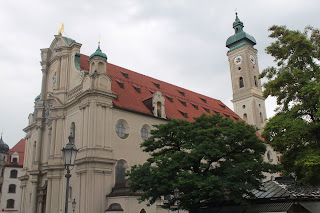
Heiliggeistkirche
Ceiling Frescoes, Heiliggeistkirche
High Altar, Heiliggeistkirche
Burgersaal is a church built in 1710. It has an Upper Church and a Lower Church. The Upper Church has a rich baroque interior with intricate ceiling frescoes. The Lower Church has a series of sculptures from the life of Christ.
Interior of the Upper Church, Burgersaal
Virgin and Child Panel at the
Lower Church, Burgersaal
Crucifixion Panel at the
Lower Church, Burgersaal
The Nailing to the Cross Panel at the
Lower Church, Burgersaal
Entombment Panel at the
Lower Church, Burgersaal
Theatinerkirche was built in 1690. The church was built by Elector Ferdinand Maria and his wife Henriette, to commemorate the birth of the heir to the Bavarian Crown, Prince Max Emanuel, in 1662. The church was built in Italian baroque style.  It has two 66 meter high bell towers and a 71 meter high dome. It has a distinctive yellow colour on its exterior.
Theatinerkirche
High Altar, Theatinerkirche
Interior of Dome, Theatinerkirche
Marienplatz is a pedestrian only square in the heart of Munich, and has been the city’s main square since 1159. In 1638, the Mariensaule, a column dedicated to the Virgin Mary, was built in the centre of the square. The Neues Rathaus (the new town hall) and the Altes Rathaus (the old town hall) both lie on Marienplatz. Other Munich landmarks like Frauenkirche, Peterskirche and Heiliggeistkirche lie close by.
Marienplatz with the Mariensaule
The Neues Rathaus on Marienplatz is where the city council office and the office of the mayor lie. In 1874, the offices shifted from the Altes Rathaus due to paucity of space. The Neues Rathaus has 400 rooms. The clock tower stands at a height of 85 meters. At regular intervals, the mechanical figures of the clock tower move, displaying a knights tournament at the wedding of Bavarian Duke William V in 1568. The celler of the building houses a restaurant, the Ratskeller.  
Neues Rathaus
Dragon Sculpture, Neues Rathaus
Mechanical Figures, Neues Rathaus
The castle shaped Altes Rathaus on Marienplatz was where the town hall was located until 1874. Its spire is one of Munich’s landmarks.
Altes Rathaus
Neuhauserstrasse is the main pedestrian street in the heart of Munich and dates back to the 13th century. It goes from Karlsplatz, past the church of Burgersaal, then the city’s main square, Marienplatz, and beyond, for a total length of 350 meters. A section of the street is known as Kaufingerstrasse. The street is full of shops and restaurants.  Karlsplatz  is a large square named after Charles Theodore, Elector of Bavaria. The square has the Karlstor, a gothic gateway to the now demolished medieval fortifications. Other gateways of the city include the Isartor and the Propylaen.
Hirmer Building on Neuhauserstrasse
Kaufingertor on Kaufingerstrasse
Isartor
The Justizpalast, or Palace of Justice, was built in 1897 in neo baroque style with a large dome. The building houses the Bavarian Department of Justice and the District Court of Munich.
Justizpalast
Hofgarten is a Renaissance garden built in 1617 by Maximilan I, Elector of Bavaria. In the centre of the garden, there is a pavilion dedicated to the Goddess Diana. The Residenz lies at one end of Hofgarten. The Residenz is Germany's largest city palace, and was the residence of the city's Wittelsbach rulers. 
Pavilion, Hofgarten
Munich also has some fine museums. Alte Pinakothek is one of the world's leading art museums featuring paintings from the classical era, with some of the world's best known old masters like Albrecht Durer, Lucas Cranach, Pieter Brueghel the Elder, Jan Brueghel the Elder, Peter Paul Rubens, Rembrandt van Rijn, Francois Boucher, Leonardo da Vinci, Sandro Botticelli and Tintoretto. The nearby Neue Pinakotek has more recent art from the 19th century. It features some of the biggest artists from the period, including the likes of Francisco de Goya, and impressionist masters like Pierre Auguste Renoir, Edouard Manet, Claude Monet, Paul Cezanne, Paul Gauguin and Vincent Van Gogh. There are also sculptures by Auguste Rodin and Pablo Picasso. The Pinakothek der Moderne houses paintings from the 20th century. The Deutsches Museum is a large museum of science and technology. Glyptothek is a museum that houses Roman and Greek sculptures, and the neoclassical building was completed in 1830.
Peter Paul Rubens' Portrait of
his Second Wife, Alte Pinakotek
Boucher's The Marquis of Pompadou,
Alte Pinakotek
Tintoretto's Venus and Mars with Vulcan,
Alte Pinakotek
The Oktoberfest is an annual event in the month of October, when hoards of tourists flock to the city for its beer and Bratwurst, the famous German sausages. The Hofbrauhaus is the best known of Munich's beer halls, and it has the capacity to accommodate 10,000 people at a time! The Augustinerbrau on Neuheuserstrasse is another well known beer hall and restaurant.

Munich also has other attractions like the Schloss Nymphenburg, a beautiful baroque palace that was the summer residence of the city's Wittelsbach rulers. The city also has the 291 meter tall Olympia Turm situated in Olympiapark. Olympia Turm is an observation and broadcasting tower and was built in 1968 in time for the 1972 Olympics. It's possible to go up the tower, for lovely panoramic views, and a revolving restaurant. Nearby, there's the BMW Museum, which is very appropriate given that the auto major is headquartered there.

The city's public transport is very efficient, and a wide section of the city is connected by the U Bahn, the local metro. Getting around is simple. The central area around the Hauptbahnhof, the main station, is full of hotels, many of them fairly reasonably priced. There are also numerous restaurants, bars and strip clubs in the area. 

The fairy-tale castle of Neuschwannstein is barely a couple of hours away by train, close to the town of Fussen. I have been jinxed with that castle. The first time I tried visiting, I traveled all the way only to find that I was half an hour too late and they had closed visits for the day. I got a glimpse just from outside. The second time I made an attempt was during that fateful trip when my wife fell ill. We had prepaid tickets for a coach trip, but we had to let those go and lose a considerable amount of money. I do hope to get rid of the jinx and visit some day in the near future!

For me, Munich is one of the most interesting cities in not just Germany, but in all of Europe. The clinchers are the city's magnificent churches, its charming pedestrian city centre full of shops and eateries, its splendid museums, its grand palaces, and of course its beer and Bratwurst!

Friday, February 8, 2019

My Visual Travel Experience: Bhopal and Surroundings (Sanchi, Bhimbetka)

My wife and I visited Bhopal for a wedding in 2012. Besides attending the wedding, we made it into an enjoyable sight seeing trip and spent 4 days exploring Bhopal and nearby sites like Sanchi and Bhimbetka, two UNESCO World Heritage Sites that are worth visiting for their historical importance. We found the city to be interesting too, with its Mughal architecture (exemplified by its various mosques), its well maintained lakes bang in the heart of the city, its museums and its more modern and contemporary side.

Bhopal is the capital of the Indian state of Madhya Pradesh, and is a bustling town having a population of over 1.7 million. Bhopal has a rich history which dates back to the 11th century AD, when it was founded by Raja Bhoj of the Paramara Dynasty. The city was also ruled by Muslim rulers for a long time, and Muslim architecture and influence are evident all over the city. The town was made famous in 1984 because of the notorious and tragic gas leak from the Union Carbide Plant, which killed over 5,000 people and caused irreparable damage among thousands of others.

The Taj Ul Masjid is one of India’s largest mosques, and its minarets can be seen from most parts of the town. Work on the mosque was started in 1878 by Sultan Jehan Begum, but the mosque was fully completed only in 1971.
Taj Ul Masjid
Entrance of Taj Ul Masjid
The Jama Masjid lies in the heart of the old town, in a square referred to as the Chowk, surrounded by a busy market-place. The mosque dates back to 1837 and was built by Qudsia Begum. 
Jama Masjid
The Moti Masjid is a small, pretty mosque which resembles Delhi’s much larger Jama Masjid. The mosque was built in 1860 by Qudsia Begum’s daughter and successor.   
Moti Masjid
The Rashtriya Manav Sanghralaya, also called the Museum Of Man, lies spread over a sprawling complex which is 99 acres in size. It has exhibits on tribal art, music, and dwelling units, and it is an interesting museum for anyone interested in tribal life and the history of man.
Madhubani Painting of Radha Krishna,
Rashtriya Manav Sanghralaya
Manipuri Krishna Leela, Rashtriya Manav Sanghralaya
Myth of King Shalesh, Rashtriya Manav Sanghralaya
Terracotta Figures, Rashtriya Manav Sanghralaya
The Laxmi Narayan Temple is one of the town’s best known temples and was built by the Birla industrialist family. It is right next to the Birla Museum, which houses stone sculptures from the 7th to the 12th centuries AD. 
Laxmi Narayan Temple
Hanuman Shrine at
Laxmi Narayan Mandir
The centre of Bhopal has two lakes – the Upper Lake and the Lower Lake.  Both lakes are fairly well maintained and are cleaner than a lot of other urban lakes in Indian cities. The Upper Lake is the larger and more popular of the two. There is a boat club from where one can hire different types of boats, and that’s a favourite past time for locals and visitors alike. The boat club has a food court. It also has an exhibit of a railway engine.
Boat Club at the Upper Lake
Railway Engine at the Boat Club, Upper Lake
The Raja Bhoj Statue lies along the banks of the Upper Lake, and is dedicated to the 11th century king who founded Bhopal.
Raja Bhoj Statue
The Van Vilas National Park is a large national park close to the Upper Lake. The best way to see the park is by road, and one can stop at regular intervals to see the large collection of animals, including tigers, lions, leopards, jackals, deer, crocodiles, turtles and snakes. The only unfortunate part I found was that in many cases, the animals are barely visible as they are at far corners of their enclosure.
Deer, Van Vilas National Park
Tiger, Van Vilas National Park
Bhojpur is a small town about 30 km south east of Bhopal. The place is famous for the Bhojpur Shiv Temple, which dates back to the 11th century AD, and was constructed by Raja Bhoj, the founder of Bhopal. The most striking feature of the temple is the large granite linga inside. The linga is 2.3 meters in height, and has a circumference of 5.3 meters. The temple also has some intricately carved pillars and a beautiful ceiling. It is not know why construction of the temple was never fully completed.
Bhojpur Shiv Temple
Linga of Bhojpur Shiv Temple
Bhimbetka is a UNESCO World Heritage Site famous for its rock paintings dating back to 10,000 BC. Situated about 45 km south east of Bhopal, Bhimbetka Rock Shelters complex consists of a series of 15 rocks where prehistoric man used to live, and several of these rocks have rock paintings of animals and man. The Bhimbetka Rock Shelters were discovered in 1957 by the Indian archaeologist VS Wakanker.
Rock Shelter 1, Bhimbetka
Rock Shelter 4, Bhimbetka
Sanchi was founded in the 3rd century BC by Emperor Ashoka, a follower of the Buddha. Between the 3rd century BC and the 7th century AD, Sanchi was a busy Buddhist centre. By the 14th century AD, it became half forgotten and it wasn’t till the 19th century that it was rediscovered by the British and restored to its former glory. In 1989, it was declared a UNESCO World Heritage Site. The complex has several stupas and other structures, and lies about 50 km north east of Bhopal.


Dominating the complex at Sanchi is the Grand Stupa with its detailed four gateways that are intricately carved. The gateways depict scenes from the life of the Buddha.  Today Sanchi is a busy pilgrimage site for Buddhists, and there are many Buddhist pilgrims who visit from countries like Japan and Thailand. Despite the age of the complex, it is in surprisingly good condition and is a fine example of great work done by the Archaeological Survey of India. 
Southern Side, Grand Stupa
Eastern Side of Gateway, Grand Stupa
Stupa 2 lies a little away from the other structures, and one has to descend a flight of stairs to get to it. It doesn’t have a gateway, but has a carved stone railing that encircles it. 
Stupa 2, Sanchi
Stupa 3 was built in the 2nd century BC. It has a single gateway. It used to contain the relics of 2 of Buddha’s disciples – Sariputra and Maudgalayana.  
Stupa 3, Sanchi
Sanchi Chetiyagiri Vihar is a temple near the entrance of the Sanchi complex, and was built by Sri Lanka. 
Sanchi Chetiyagiri Vihar
Painting of the Reclining Buddha, Sanchi Chetiyagiri Vihar
Bhopal was interesting, Bhimbetka Rock Shelters were an education that took us to another era in the history of man, but Sanchi was a breathtaking and spiritual experience, and my wife and I were very impressed not just by the intricate stupas and gateways built over two thousand years ago, but also by the calm, serene and spiritual atmosphere that prevailed there.

Friday, February 1, 2019

My Visual Travel Experience: Bregenz, Austria

In the summer of 2018, my wife Kamalini, my 3 year old son Rehaan, and I spent a couple of weeks in Switzerland. We also visited Liechtenstein, and then crossed the border into Austria and visited the town of Bregenz. During my 4 years in Austria from 1985 to 1989, I never managed a trip to Bregenz, but I'm glad we made the effort and went there during this trip of ours, because it was a very memorable visit to a charming little town. We stayed at a place called Sunny Pension, right in the heart of Bregenz's pedestrian district on Kaiser Strasse. It was a pleasant enough hotel, and we liked our stay there, except for the shared bathrooms (they were clean, but they were shared nevertheless)!

Bregenz is the capital of the Austrian province of Vorarlberg, which is the country’s western most province. The town has a population of close to 30,000 and lies along the Bodensee (also called Lake Constance), a large lake that lies between Austria, Switzerland and Germany. The town lies on the foothills of Pfander Mountain.

The first settlement in the region was around 1500 BC. In the 5th century BC, the Celts settled here. The Romans conquered the area in 15 BC and the town became a Roman camp. In 260 AD, the town was destroyed by the Germans. From 917 AD onwards, the Counts of Bregenz were in power, all the way until 1150. In the 16th century AD, the Habsburgs took control and the town came under Austrian rule. Briefly, from 1805 to 1814, Bregenz was under Bavarian control. It then went back to Austria and has continued as the capital of Vorarlberg.

Pfarrkirche St Gallus is one of the town's most important churches. There was a church at this spot in the 5th century AD. It went through several rounds of reconstruction over the centuries, but the present church was built 1737. It is a baroque church with a rich interior.
Pfarrkirche St Gallus
Nave, Pfarrkirche St Gallus
Baptism Altar, Pfarrkirche St Gallus
Martinsturm was built as a granary in 1601.  It has a distinctive onion shaped tower. From the top, there are good views of the town. The chapel inside is said to have served the Counts of Bregenz.
Martinsturm
Interior of Chapel, Martinsturm
Pfarrkirche Hertz Jesu, or the Sacred Heart Parish Church, was built in 1908, largely through donations from citizens. The brick church has two towers, each one measuring 62 meters in height.
Pfarrkirche Hertz Jesu
High Altar, Pfarrkirche Hertz Jesu
Seekapelle is a chapel near the Rathaus and lies off Kornplatz, one of the town’s main squares. The chapel dates back to 1663.
Seekapelle
Interior, Seekapelle
The Johannes Nepomuk Kapelle, or the Chapel of St John Nepomuk, was built in 1757. The circular shaped, small chapel has a baroque interior.  
Johannes Nepomuk Kapelle
High Altar, Johannes Nepomuk Kapelle
Bodensee lies between Austria, Switzerland and Germany. The lake has a surface area of 536 sq km. Its maximum length and width are 63 km and 14 km respectively.
Boats, Bodensee
Ferry, Bodensee
Bregenzer Festspiele was founded in 1946. It has a floating stage with 7,000 seats and there are operas and other musical performances that take place with the backdrop of the Bodensee.
Bregenzer Festspiele
The Post Office was built in 1895, near the Bodensee. The building is very grand and palatial in its construction, and was built along the lines of the Post Office in Bad Ischl.
Post Office
The Pfander Bahn opened in 1927. The cable car connects Bregenz to the Pfander Mountain at a height of 1022 meters above sea level.  In 1994, the cable car system was extensively renovated. At the top, there is a popular restaurant, an Alpine zoo (with animals like mountain goats and wild boars), and rides for children. There are great views from the summit of Bodensee, Bregenz and the surrounding mountains.
Pfander Bahn
View of Bregenz and Bodensee from Pfander
Mountain Goat at the Alpine Zoo at Pfander
In Bregenz, one is spoiled for choice when it comes to restaurants and cafes. There are many eateries near Bodensee (Pier 69 is a well known eatery along the Bodensee) and in the pedestrian area (Ristorante Isola Bella and Ristorante Pizzeria Da Guiseppe are popular Italian restaurants in the pedestrian district; Der Backer Ruetz is a popular cafe on Kaiser Strasse). There is also a very good restaurant on the Pfander Mountain, from where one can enjoy fabulous views while eating. One can enjoy Austrian specialities like Wiener Schnitzel and Apple Strudel.
Wiener Schnitzel at the Restaurant on Pfander
Apple Strudel and Cappuccino at Der Backer Ruetz
We just had a day in Bregenz, but it is a fairly small and compact town and we managed to cover it quite extensively. The highlights were the stunning Bodensee, the spectacular views from the Pfander, the pretty churches, and the delicious Austrian cuisines that we got to taste. Most visitors to Austria end up going to Vienna, Salzburg and Innsbruck, but the beautiful country has a lot of lesser visited hidden gems like Bregenz!