Friday, January 24, 2020

My Visual Travel Experience: Bremen

Back in the summer of 2007, I managed to take 3 weeks off from work, and I traveled around Europe by Eurail. I covered three countries - Germany, Italy and Denmark. It was a memorable trip, but I made the mistake of walking extensively without proper walking shoes, and I came back with a problem in my heels that went on to become a chronic problem.

My travels around Germany also took me to the medieval town of Bremen. It turned out to be a special visit to Bremen, because unlike everywhere else on that solo trip, I had company because I was staying with Antje, a German friend of my elder sister's, who lived in Bremen and worked in the nearby city of Hamburg. Antje had been with my sister in college in England years earlier, and they had kept in touch. She was very hospitable, and lent be her bicycle while I was in Bremen. The town is small enough to cover by bicycle, and I had a good time riding into town and exploring its stunningly beautiful medieval architecture.

A pretty town in northern Germany with a population of about 570,000, Bremen historically owes its prosperity to its coffee and wool trade. In modern times, its has been a major source of income for the country - the town’s port, Bremerhaven, ships hundreds of thousands of cars each year. The town was damaged extensively by allied bombings during World War II, but it was subsequently restored with a lot of care.

Marktplatz lies in the heart of the old town, and is famous for its buildings with gabled roofs. The square is no longer used as a market place, except during festivals like Christmas and the Freimarkt Fair in late October. Marktplatz dates back to the early 15th century AD. Several of Bremen's landmarks lie along Marktplatz. The square is a popular tourist attraction and has shops and restaurants, buzzing with visitors.
Marktplatz
The Rathaus, or City Hall, lies on Marktplatz and is the seat of the President of the Senate. The Rathaus consists of the Altes Rathaus (the Old City Hall) and the Neues Rathaus (the New City Hall). The former dates back to the 15th century AD, and the latter dates back to the 20th century AD. The Gothic Altes Rathaus has many treasures including a spiral staircase, the Upper Hall, the Golden Chamber, the Lower Hall and the Ratskeller (a celler for storing wine). The Neues Rathaus has the Banquet Hall, the Fireplace Room, the Gobelin Room and the Senate Hall.
 Rathaus
The Statue of Roland at Marktplatz is dedicated to the nephew of Emperor Charlemagne. Roland was the legendary protector of the town and the statue shows him with his sword and shield with its two headed imperial eagle. According to legend, Bremen will remain free and independent as long as Roland stands watch over it. The original wooden statue dated back to the 10th century AD but was destroyed in 1366 by Prince Archbishop Albert II. The current statue was built in 1404. It is over 5 meters in height, and the column behind it is over 10 meters tall. 
Statue Of Roland
Bremer Dom is the town’s main cathedral and is dedicated to St Peter. It also lies on Marktplatz. The inner courtyard of the cathedral has the statue of Sankt Jakob. Above the entrance, there is the statue of Charlemagne. The cathedral has twin steeples that stand at a height of 89 meters. From the top, one gets fine views of the town. The cathedral dates back to the 11th century AD, though there have been numerous additions through the centuries. There was a timber church at the site way back in the 8th century AD, but it was burned down by the Saxons just 3 years after it was built. 
Bremer Dom
Charlemagne Statue, Bremer Dom
Courtyard, Bremer Dom
The Statue of the Town Musicians is yet another landmark on Marktplatz. According to the town’s folklore, a donkey, dog, cat and rooster, all past their prime and shunned by their masters, became musicians and created such a cacophony with their singing that they scared away a group of thieves who had come to burgle a house. This statue was built in 1953.
Statue of the Town Musicians
The Schuetter building is yet another landmark at Marktplatz. This building was used by the Merchants’ Guild for their conventions. The building was completed in the 16th century AD.
Schuetter
Boechterstrasse is a charming street close to the centre of town, with experimental Art Deco architecture. The street was transformed into its current state in 1930 by Ludwig Roselius, a wealthy coffee merchant. The street is just about 100 meters long. Its highlights include the bas relief of the Lichtbringer (the Bringer of Light, dedicated to Adolf Hitler, but rejected by him), Haus des Glockenspieles (with its 30 bells of Meissen porcelain) and Roseliushaus (which houses the private art collection of Ludwig Roselius).
Lichtbringer,
Boechterstrasse
Haus des Glockenspieles, Boechterstrasse

Roseliushaus, Boechterstrasse
The Schnorr is a narrow pedestrian street with charming shops and restaurants. The buildings date back to the 15th to 18th centuries. This was one of Bremen’s poorest areas, but post 1958, it has been developed into a tourist attraction.
Schnorr
The Spielzeugmuseum, or Toy Museum, lies at the Schnorr, and has a range of early day toys including teddy bears, dolls and bicycles.
Spielzeugmuseum
Soegerstrasse is a street near the centre of town with a sculpture of a horn player surrounded by pigs, dogs and other animals.
Soegerstrasse
Bremen Hauptbahnhof is the town's main railway station. The station first opened in 1847 at its present location. The current station was completed in 1891. The station has been remodeled and renovated several times, but largely resembles the structure completed in 1891.
Bremen Hauptbahnhof
I spent 2 nights at Antje's place. One day was spent exploring Bremen, and on my second day, I caught a train and went across to Hamburg, about 120 km north east of Bremen. Bremen was really pretty and it certainly had one of the prettiest town centres that I've seen on my many travels. Most travelers to Germany tend to visit the vibrant cities of Berlin (for its history, museums and churches) and Munich (especially during the annual Oktoberfest, when beer flows like water!); or they visit Cologne for its grand Gothic cathedral; or they go to experience the stunning beauty of the Black Forest; or they go and see the charming Neuschwannstein Castle that inspired the Disneyland Castle; or they visit Germany's tallest peak Zugspitze; or they even take in the fascinating landscapes along the River Rhine by going on a river-cruise. I would however say that Bremen is certainly worth adding into one's Germany itinerary and one won't be disappointed!

Monday, January 20, 2020

My Visual Travel Experience: Hampi

My parents took me to Hampi back in 1983, when I was 10 years old. The beautiful temples and fascinating sculptures left a very positive impression in my mind, and in 1999, when I got an opportunity because my work had taken me to the area, I visited Hampi again. Then in January 2020, I took my wife and son to Hampi, for my third visit. I had a car with me, and I drove across from Bangalore. The road was unbelievably good and the distance of over 360 km took just about 6 hours, and that too, with a break for lunch. The route from Bangalore to Hampi was via Nelamangala, Tumkur and Chitradurga. The closest big town to Hampi is Hospet, and we stayed at a reasonably priced and comfortable hotel in Hospet called Hotel Malligi.

Hampi lies in the South Indian state of Karnataka. It is a UNESCO World Heritage Site. It was the capital of the Vijayanagara Empire in the 14th century AD and was a prosperous city along the banks of the Tungabhadra River, with numerous temples, farms and trading markets. It was considered one of the biggest and most prosperous settlements not just in India but anywhere in the world!

The region around Hampi was a part of the Mauryan Empire in the 3rd century BC. By the 10th century AD, it was a pilgrimage centre under the Chalukya Empire. The Hoysala Empire was in power between the 12th century and the 14th century. In the early 14th century, the armies of the Delhi Sultanate under Alauddin Khalji invaded and pillaged the region, and the Hoysala Empire was destroyed. The Kampili Kingdom followed, but it did not last long and ended after an invasion by the Sultanate under Muhammad bin Tughlaq. The Vijayanagara Empire arose from the ruins of  the Kampili Kingdom in 1336 AD, and it ruled for the next 2 centuries. In 1565 AD, the Vijayanagara Empire  was defeated by a coalition of Sultanate armies, the king (Aliya Rama Raya) was beheaded, and the city was pillaged and left largely in ruins. These ruins are what are now collectively known as the Group of Monuments at Hampi.


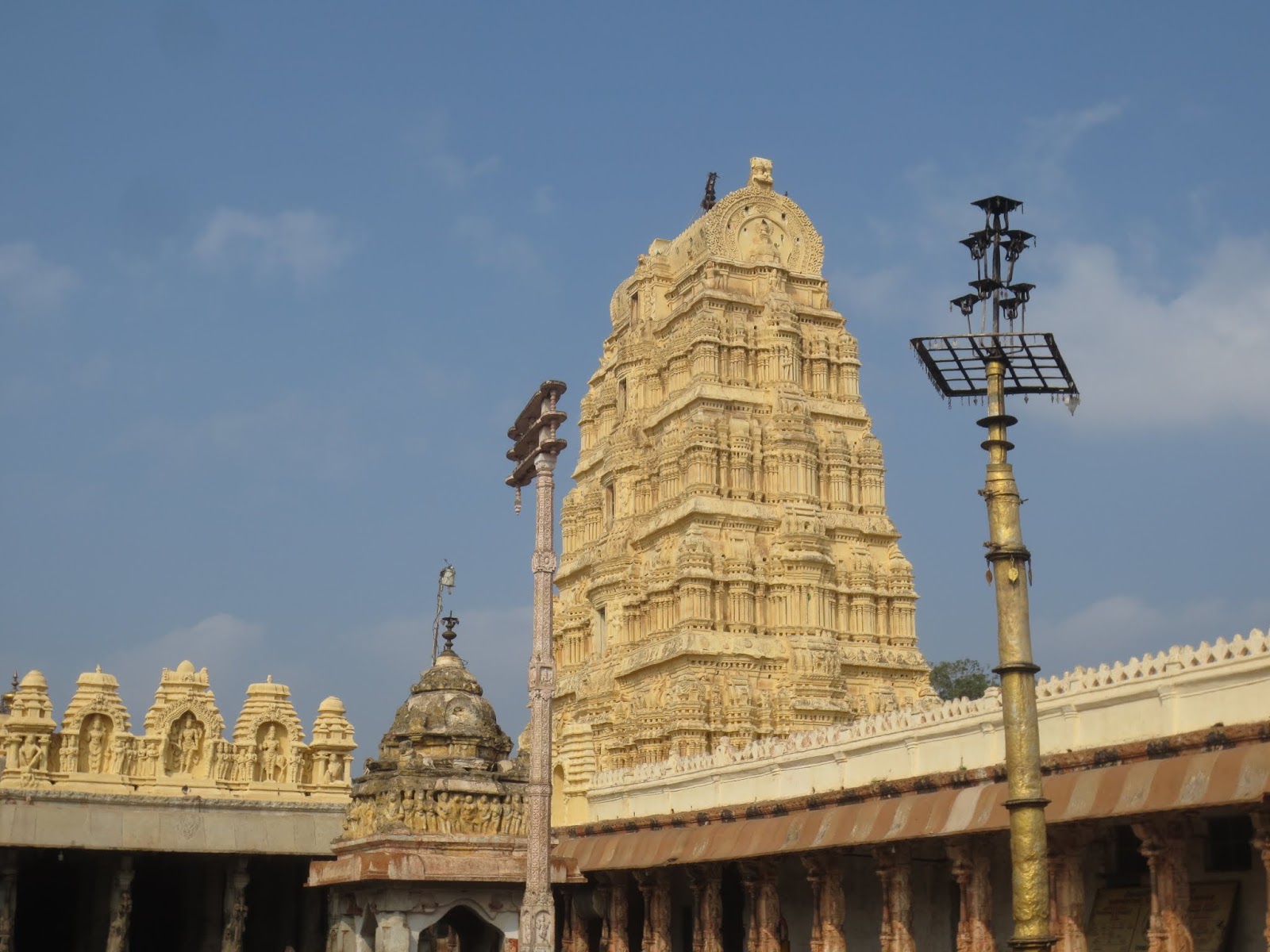
Virupaksha Temple dates back to the 7th century AD, well before the Vijayanagara Empire. The temple underwent a lot of expansion during the Vijayanagara Empire, under the directions of Lakkana Dandesha, a chieftain who served under the ruler Deva Raya II. Parts of the temple were also built in 1510 by Krishnadevaraya, to mark his accession to the throne. The city was destroyed in 1565, but Virupaksha Temple continued to be a place of worship. The temple gateway is 50 meters tall and is intricately carved. On our visit, we saw a temple elephant blessing pilgrims and children as they placed fruits and money into its trunk. The temple complex was also full of monkeys, but they were a harmless lot, very used to pilgrims and visitors.
Gopuram, Virupaksha Temple
Nandi, Virupaksha Temple
Ganesha Idol, Virupaksha Temple
Hanuman Idol, Virupaksha Temple
Temple Elephant, Virupaksha Temple
Monkeys, Virupaksha Temple
Vitthala Temple is famous for its stone chariot in the temple courtyard. The temple dates back to the mid 16th century. It has a large entrance gopuram, intricately carved with sculptures of gods. Outside the temple, there is a long colonnaded  market street that is largely in ruins.
Stone Chariot, Vitthala Temple
Entrance Gopuram, Vitthala Temple
Pillars, Vitthala Temple
Lakshmi Narasimha Temple has a 6.7 meter tall monolithic statue of Narasimha, the half man, half lion reincarnation of Lord Vishnu, who came to earth to rid it of the feared demon Hiranyakashyap. The statue originally also featured Vishnu’s consort, Lakshmi. This statue has gone on to become almost synonymous with Hampi, and is one of its most visited sites.
Lakshmi Narasimha Temple
Badaviling Temple has a 3 meter tall monolithic linga standing on water. It lies right beside the Lakshmi Narasimha Temple.
Badaviling Temple
Hazararama Temple dates back to the early 15th century. The temple is dedicated to Lord Rama. The inner walls of the temple have friezes depicting scenes from the Ramayana. The outer walls have friezes showing Hindu festive processions.
Hazararama Temple
Detail, Hazararama Temple
Kadalekalu Ganesha is named after Ganesha’s gram shaped belly, and has a 4.5 meter tall monolithic statue of Ganesha.
Kadalekalu Ganesha
Sasivekalu Ganesha is named after Ganesha’s mustard seed shaped belly, and has a 2.4 meter tall monolithic Ganesha statue.
Sasivekalu Ganesha
Elephant Stables consist of 11 square chambers. The openings to the chambers are arched, and the chambers are topped by domes. The chambers are of course large enough to accommodate elephants.
Elephant Stables
Lotus Mahal is constructed in Hindu temple architectural style. The purpose of this structure is unclear, but it is believed that it was used as a council hall. Lotus Mahal lies next to the Elephant Stables.
Lotus Mahal
Queen’s Bath is a square shaped stone structure, with a bathing area inside, and was apparently used by the queen for her baths. The corridors running along the four sides feature arches and domes.
Queen's Bath
Interior, Queen's Bath
Dome, Queen's Bath
So we had a fascinating time exploring the sites of Hampi, and found ourselves going back to another era. It was unfortunate that the city was left in ruins, but many of the temples and sculptures are fairly well preserved. We had a full day in Hampi. It was certainly not enough to see all the various sites, but it was adequate to see the main temples and sculptures. Having a car with us made our visit that much easier, because the ruins of Hampi are scattered over a large area, and it would have been impossible to cover everything on foot. There are of course autos that are easily available but given the hot, sunny day that it was, our air conditioned car made it a comfortable visit. If one is in Bangalore and has a few days to spare, I would say Hampi should certainly not be missed!

Sunday, December 1, 2019

My Visual Travel Experience: Philadelphia

My association with Philadelphia goes back a long time. I grew up hearing about Philadelphia, because way back in 1951, my father finished his graduation from Wadia College, Pune, and went to the University of Pennsylvania, Philadelphia, as a Full Bright Scholar for his Masters in Political Science. In 2003, I visited the East Coast of the USA. I made it a point to visit Philadelphia on that trip. Later, I went to New York on a company workshop in 2006, and this time too, I visited Philadelphia. Then in 2008, my company sponsored me for a 5 day workshop at Wharton Business School in Philadelphia, and that was my third visit to the city. Staying at the campus of the University of Pennsylvania, I managed to visit the street (Spruce Street) where my father had lived for 2 years, more than 5 decades earlier! From there, I phoned him back in Delhi, very excitedly, to tell him about it, and it was a moment of great connection between father and son!

Philadelphia is the largest city in the US state of Pennsylvania, and has a population of over 1.5 million. This makes it the 6th largest city proper in the USA, after New York, Los Angeles, Chicago, Houston and Phoenix. Philadelphia has a very interesting history, and is one of the oldest cities in the USA. It was founded by William Penn, an English Quaker, in 1682. Philadelphia is Greek for “brotherly love”, and Penn signed a peace treaty with the local American Indians, with “brotherly love” being the theme of the treaty. Being a Quaker, Penn believed in religious tolerance and this led to the city being a peaceful one and it saw rapid growth and development. The city was an important place in the American Revolution. The Declaration of Independence was signed here in 1776, as was the Constitution in 1787. Till 1790, Philadelphia was the largest city in the USA, before New York overtook it. It was also briefly the country’s capital from 1790 to 1800, before it shifted to Washington DC. Philadelphia has many landmarks that commemorate its rich historical legacy.

Independence Hall is the building where the US Declaration of Independence and US Constitution were debated and signed. The Declaration of Independence was approved on July 4th, 1776 and read out to the public. The date is celebrated as Independence Day in the USA. The Constitution was completed in 1787 and came into effect from March 4th, 1789. The building itself was completed in 1753 and served as the Pennsylvania State House till 1799, when the state capital was shifted to Lancaster.
Independence Hall
Liberty Bell lies opposite Independence Hall. It is a symbol of American Independence. It was once situated inside Independence Hall. It was commissioned from London in 1752 by the Pennsylvania Provincial Assembly. It was one of the bells that were rung on July 8th, 1776, to celebrate the reading of the Declaration of Independence. The bell acquired its large crack in the early 19th century.
Liberty Bell
Philadelphia City Hall is the seat of government for the city. It was completed in 1901 and stands at a height of 167 meters. The tower is topped by an 11 meter bronze statue of William Penn, the city’s founder.  
Philadelphia City Hall
The Masonic Temple dates back to 1873. The grand structure was designed in the medieval Norman style. It features the Masonic Library and Museum of Pennsylvania. It has seven lodge rooms and the Free Masons still conduct their meetings there.
Masonic Temple
City Tavern is a 20th century building that is a replica of an 18th century building which stood at the site. It currently serves as a restaurant, with staff dressed in period costumes. The tavern was used by the founding fathers of the USA, and was used for important events, like the first anniversary of the country’s independence.
City Tavern
Betsy Ross House is the house where Betsy Ross (1752 – 1836) lived. She was a seamstress who stitched the first flag of the USA. Historians are not sure if she lived in this exact house or if it was one of the houses adjacent to it.
Betsy Ross House
First Bank of the USA was set up in 1791. It was a national bank, set up with a charter of 20 years by the US Congress.
First Bank of the USA
Second Bank of the USA was set up in 1816, again with a charter of 20 years.
Second Bank of the USA
Christ Church was founded in 1695 by members of the Church of England. The structure with its 60 meter tall steeple was completed in 1754. In later years, the church underwent major changes. The church has the original baptismal font where William Penn was baptized. 
Christ Church
Benjamin Franklin’s Grave lies in Christ Church Burial Ground. The versatile and talented writer, politician, scientist, inventor died in 1790 at the age of 84.
Benjamin Franklin's Grave
Philadelphia Museum of Art was completed in 1828. It lies along Benjamin Franklin Pathway , at a circle called Eakin Oval, which has the Washington Memorial Fountain (featuring a bronze equestrian statue of the leader surrounded by native Americans and animals). The museum has over 240,000 exhibits. There are collections from China, Japan, and India. 

Philadelphia Museum of Art
The museum has an impressive collection of European paintings (including the likes of El Greco and Rubens), impressionist art (featuring artists like Van Gogh, Renoir, Cezanne, Lautrec, Manet and Monet) and modern art (with artists like Picasso and Dali).
Monet's Japanese Bridge at the Water Lilly Pond,
Philadelphia Museum of Art
Cezanne's The Bathers, Philadelphia Museum of Art
Public Domain, Credit: Google Art
Renoir's The Large Bathers, Philadelphia Museum of ArtPublic Domain, Credit: Google Art
Van Gogh's Sunflowers, Philadelphia Museum of ArtPublic Domain, Credit: Google Art
Rubens' Prometheus Bound, Philadelphia Museum of ArtPublic Domain, Credit: Google Art
Rogier van der Weyden's Cricifixion Diptych,
Philadelphia Museum of Art
Public Domain, Credit: Google Art
Rodin Museum opened in 1929 and has the largest collection of the artist’s sculptures outside Paris. The museum has works like The Thinker, The Kiss, The Burghers of Calais and The Gates of Hell.
Rodin Museum
Pennsylvania Academy of Fine Arts was founded in 1805 and is the oldest art museum and art school in the USA. The museum features works of art by famous American artists like Thomas Eakins.
Pennsylvania Academy of Fine Arts
Washington Square is a large park in the heart of the city. In 1954, a decision was taken to construct a monument which had the remains of an unnamed soldier. The monument was called the Tomb of the Unknown Soldier, and it has a bronze cast of Houdon’s statue of Washington at the centre. The monument was dedicated to the soldiers of the Revolutionary War. There are a large number of bodies buried under the park.
Tomb of the Unknown Soldier, Washington Square
Love Sculpture at JFK Plaza is inspired by pop art made by Robert Indiana. The original was featured in a Museum of Modern Art Christmas card in 1965. It was the symbol of hippie free love in the 1960’s.
Love Sculpture, JFK Park
Liberty Place is a skyscraper complex in the heart of the business district. It consists of two towers. One Liberty place has 61 floors and a height of 288 meters (945 feet). Two Liberty Place has 58 floors and a height of 258 meters (848 feet). The towers were completed in 1987 and 1990 respectively, and went against a gentleman’s agreement that no structure in the city would be taller than the City Hall. They house office complexes, a hotel and a shopping mall.
Liberty Place
Logan Circle is a circle in the city centre, that has the famous Swann Memorial Fountain. The fountain is dedicated to William Cary Swann of the Philadelphia Fountain Society. The fountain has Native American figures symbolizing the regions major rivers. The fountain also features sculptures of frogs and turtles.
Logan Circle
University of Pennsylvania is a private ivy league university founded in 1740. Benjamin Franklin was the university’s founder and first president.
Benjamin Franklin Statue,
University of Pennsylvania
Benjamin Franklin Statue at Locust Walk,
University of Pennsylvania
I enjoyed visiting Philadelphia and learning about its fascinating history. Along with Boston, it is the city that is most closely linked to the American Independence movement. It's barely a one and a half hour train ride away from New York, so that makes it very accessible for anyone visiting New York.