Tuesday, May 5, 2020

My Visual Travel Experience: Porto

During our two week trip to Portugal in 2012, my wife and I spent three days in and around Porto. We spent a day in the main city, a day in the Douru Valley just outside the city, and a day visiting the nearby Bom Jesus Do Monte Church. The beautiful churches of Porto, the stunning vineyards around the Douro River and the magnificent Bom Jesus Do Monte Church all left us with wonderful memories of the northern region of the country.

Porto, also called Oporto, is the second largest town in Portugal after the capital Lisbon, and has a population of approximately 235,000. It lies to the north of the country along the Douro River estuary. The Atlantic Ocean lies to the city’s west. In 1996, the historic city centre was declared a UNESCO World Heritage Site. Porto is famous for its Port wine, which is grown in the vineyards of the nearby Douro Valley.

Porto was a major port during the Roman occupation of the Iberian peninsula. In the 8th century, Porto was occupied by the Moors. In 868, Count Vimara Peres founded the country of Portugal and re-established Christian rule. In the 14th and 15th centuries, Porto was known for its shipbuilding. It was also an integral part of the Portugese Age of Discovery, as many navigators set off from the port of Porto to discover far-off unexplored lands.

In 1809, Napoleon’s troops brought war to the city. The population fled from the city and tried crossing the Douro River across a pontoon bridge. This led to the bridge collapsing. The French forces were eventually driven out of Porto by Arthur Wellesley, 1st Duke of Wellington.

In 1828, Miguel I took over the throne of Portugal. He reigned as an absolutist monarch. A civil war was fought from 1828 to 1834. Miguel I finally abdicated, and the liberal constitution was re-established. In 1891, there was a revolt against the monarchy which led to the overthrow of the monarchy in 1910 and the setting up of the republic. In 1919, there was a counter revolution in favour of the monarchy and Porto was the capital of the restored kingdom. This did not last beyond a month. No pro monarchy revolution ever took place again.

Porto's Town Hall is a splendid neoclassical building, built between 1920 and 1956. It has a monumental clock tower and is one of the city’s best known landmarks.
Town Hall
Praca de Liberdade is a large square in the heart of Porto. Its history goes back to the early 18th century. The Monument to Pedro IV lies in the centre of the square, showing an equestrian statue of the monarch holding the constitution.
Pedro IV Statue, Praca de Liberdade
Se do Porto was completed in 1737. The cathedral has two bell towers. It has a treasury with valuable religious artefacts. The cathedral also has a grand rose window.
Se Do Porto
High Altar, Se Do Porto
Crucifix in the Treasury, Se Do Porto
Silverware in the Treasury, Se Do Porto
Igreja dos Clerigos was completed in 1763 and has a tower with a height of 75 meters. 240 steps lead visitors to the top of the tower, for stupendous views of the city. The church was built for the Brotherhood of the Clergy. It has a rich baroque interior.
Igreja dos Clerigos
High Altar, Igreja dos Clerigos
View of the Town Hall from the summit of the tower at
Igreja dos Clerigos
Igreja dos Congregados is a church built in 1703. known for its tile panels on the exterior.
Igreja dos Congregados
Pulpit, Igreja dos Congregados
Igreja de Santa Clara is a catholic church whose construction began in the 15th century. The church has been expanded several times subsequently over the next few centuries. The interior of the church is covered in gold and polychrome.
High Altar, Igreja de Santa Clara
Ceiling, Igreja de Santa Clara
San Bento Station was completed in 1916. The main attractions of the station are the tile panels showing scenes from the country’s history and depicting rural scenes.
San Bento Station
Ponte Dom Luis I is a bridge  over the river Douro that was inaugurated in 1886. It is 172 meters long. It stands at a height of 85 meters above the river.
Funicular Track, Ponte Dom Luis I

The Douro Valley lies around the Douro River. The river has a length of 897 km. The Douro Valley is famous for its Port wine. The area has been designated as a UNESCO World Heritage Site. 
Douro Valley
Wine Farms, Douro Valley
Fonseca Wine Farm, Douro Valley
Church of Sao Goncalo lies in the small town of Amarante, which has a population of 11,000 and lies about 70 km east of Porto in the Douro Valley. The church is dedicated to Sao Goncalo, a Dominican friar who lived from 1187 to 1259. He settled in the area and was instrumental in developing it, including building the stone bridge over the Tamega River.
Church of Sao Goncalo
Nave, Church of Sao Goncalo
Cloister Corridor, Church of Sao Goncalo
Bom Jesus Do Monte is a church that lies 15 km from the town of Braga and 60 km from Porto. The church was completed in 1725. A staircase that climbs  116 steps leads up to the church. The stairway has a series of chapels dedicated to the Passion of Christ. The stairway also has a zigzag section dedicated to the five senses. As per tradition, pilgrims climb up on their knees. In 2019, the church was made a UNESCO World Heritage Site.
Bom Jesus Do Monte
Facade, Bom Jesus Do Monte
Nave, Bom Jesus Do Monte
High Altar, Bom Jesus Do Monte
We had rented a car in Lisbon to drive to Porto, so getting around in the region was not difficult. It is unfortunate that immediately after this leg of our trip, we were robbed of our passports and most of our valuables on a train in Lisbon, as we were on our way to Madrid, and we had to rush back to India. A sad end to a beautiful trip!

Sunday, May 3, 2020

My Visual Travel Experience: Canberra

In 2011, I spent over a month traveling around Australia. I spent four days in Canberra. Canberra is a relatively small and quiet city, compared to the much larger and more vibrant Australian cities of Sydney and Melbourne. My stay in Canberra was that much more special because I caught up with two old friends. First there was Akshay Mishra, with whom I stayed as a house guest. He moved to Australia many years ago, and started working there as a doctor. He and I were the best of friends as kids in the late 1970s when we lived in Thimpu. Our parents were friends too, so the friendship cut across generations. We had stayed in touch off and on after we left Thimpu. Then I caught up with my Australian friend Greg Wilde. He and I were together in junior school in Belgrade in the mid 1980s. He was a small-built little fellow back then. A quarter of a century later, he had transformed into this big, tall guy, but he still had the same warmth that he had had all those years ago. We had a great time talking about the good old days in Belgrade, our school, our common friends like Peter Vanderwal, and our childhood chess encounters.

Canberra, the capital of Australia, is a city having a population of 425,000 (2019). It lies within the Australian Capital Territory, 280 km south-west of Sydney, and 660 km north-east of Melbourne. White settlement in Canberra started in the 1820s. In 1901, the Commonwealth of Australia was formed following the Federation of the Colonies. A decision was taken to establish a new capital, and Canberra was founded and made the capital city in 1913. Canberra is an entirely planned city, and following an international contest, the project was given to American architects Walter Burley Griffin and Marion Mahony Griffin.

After World War II, people were critical of Canberra, because it was not like a city and was more of a village with a group of suburbs that had been brought together. In 1964, Lake Burley Griffin was completed. This was the centre-piece of the city’s original architectural plan. Subsequently, several buildings of national importance were built around the lake, including the National Library, the High Court and the National Gallery. In 1988, a new Parliament House was built, in lieu of the much smaller Provisional Parliament House. Lake Burley Griffin divides the city in two, running in an east-west direction. The Parliament House lies to the south, and to the north, one has Anzac Parade leading up to the War Memorial.

New Parliament House opened in 1988. Until 1927, parliament meetings were held in Melbourne. Between 1927 and 1988, meetings were held in the Provisional Parliament House. The New Parliament House is huge, and has 4,700 rooms. The House of Representatives Chamber has a green colour scheme and the Senate Chamber has a red colour scheme. The foyer has a grand staircase leading to the Great Hall.
New Parliament House
House of Representatives Chamber,
New Parliament House
Senate Chamber,
New Parliament House
Old Parliament House was formerly called the Provisional Parliament House and was the seat of parliament from 1927 to 1988. It now houses the Museum of Australian Democracy. King’s Hall inside the building has a large bronze statue of King George V.
King George V Statue at King's Hall,
Old Parliament House
Portrait of John and Janette Howard,
Old Parliament House
Statue of King George V,
Old Parliament House
Australian War Memorial was opened in 1941 and is a memorial dedicated to members of the armed forces who fought in wars for the Commonwealth of Australia. Anzac Parade leads up to the Australian War Memorial.
Australian War Memorial
Interior of Dome,
Australian War Memorial
Exhibit on Soldiers from Australia and New Zealand,
Australian War Memorial
View of Anzac Parade,
Australian War Memorial 
Anzac Parade is a boulevard that is used for ceremonial occasions. The Australian War Memorial lies at one end of the boulevard. Along its length, one has several memorials, including the Vietnam War Memorial, the Army National Memorial, the Hellenic Memorial, the Korean War Memorial and the Kemal Ataturk Memorial.
Army National Memorial,
Anzac Parade
Hellenic Memorial,
Anzac Parade
Korean War Memorial,
Anzac Parade
Vietnam War Memorial,
Anzac Parade
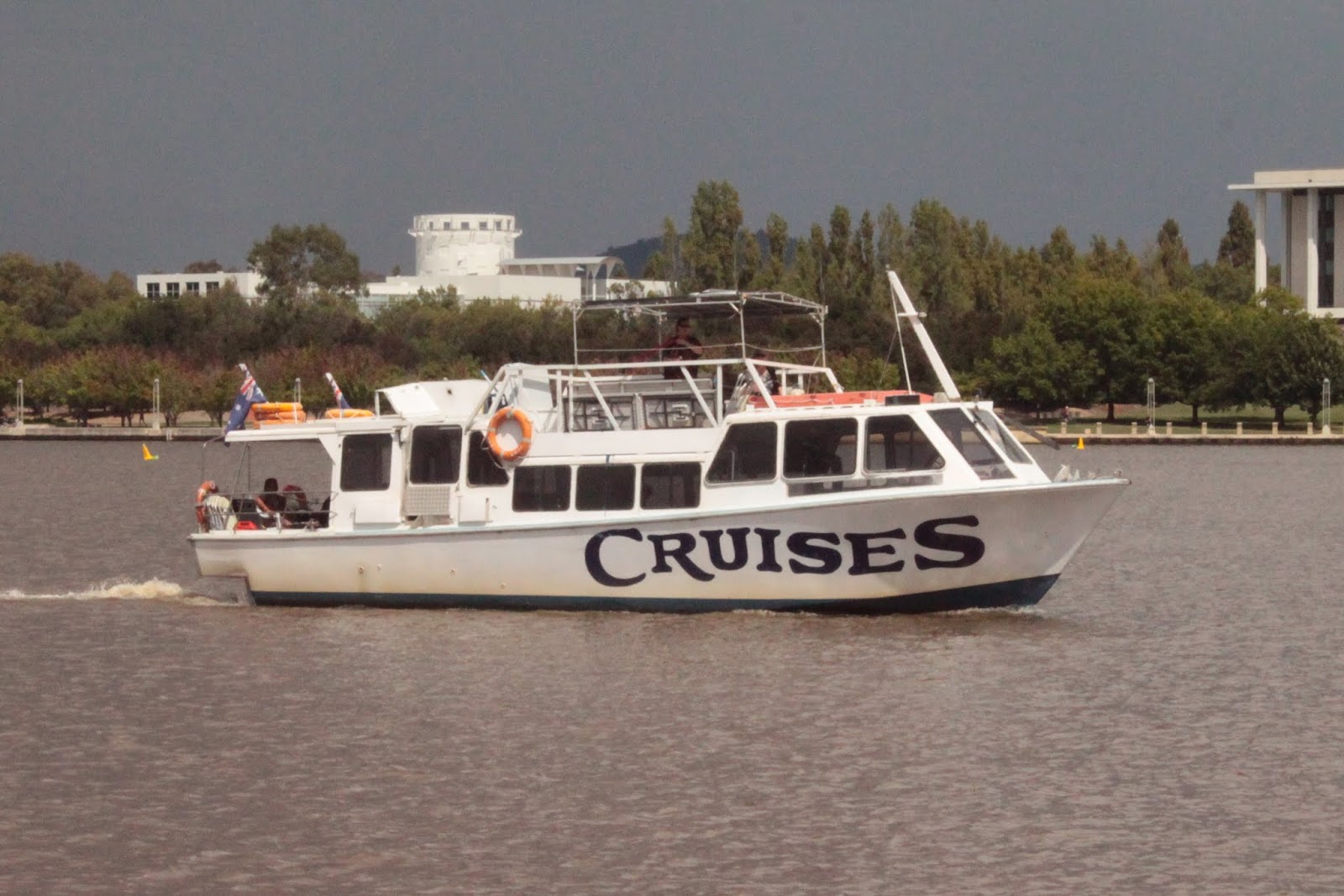
Lake Burly Griffin is an artificial lake in the centre of Canberra built in 1963. Many of the city’s landmark buildings lie along its shores. The lake has a length of 11 km and a width of 1.2 km at its widest point. The Captain James Cook Memorial was built in 1970. It includes a jet fountain, inspired by Geneva’s Jet d’eau.
Cruise Boat,
Lake Burley Griffin
Captain Cook Fountain,
Lake Burley Griffin
The National Carillon was set up in 1970 as a gift from the British Government to commemorate 50 years of Canberra being the capital. It stands on the shores of Lake Burley Griffin. The structure has a height of 50 meters. It has a total of 55 bells. The bells have a weight of between 7 kg and 6 tonnes! The bells chime every quarter-hour and play a short tune on the hour.
National Carillon
Australian National Museum is the city's largest museum. It was established in 1980 but moved to its current building only in 2001. The museum has exhibits on the country's Aboriginal history, the white settlements since 1788, navigation instruments used by Captain Cook and the Sydney Olympics in 2000, including many others.
Exhibit on the "Buffalo Catcher",
Australian War Memorial
Exhibit on a Boat used by the Aboriginals,
Australian War Memorial
Canberra Zoo and Aquarium lies to the west of Lake Burley Griffin. It is spread over an area of 47 acres. The zoo has Australian animals like kangaroos, wallabies, emus and dingos, plus a collection of animals from around the world, including lions, tigers, leopards, cheetahs, bears, rhinos, giraffes, zebras and monkeys.
Kangaroo, Canberra Zoo and Aquarium
Emu, Canberra Zoo and Zquarium
Lion, Canberra Zoo and Aquarium
Giraffe, Canberra Zoo and Aquarium
Cockington Green Garden is a miniature village that opened in 1979. It has miniatures of Stonehenge, Petra and other structures. It also has miniature models of people and scenes from well known movies.
The Long Man of Willmington and the White Horse of Uffington,
Cockington Green Garden
Model of the Entrance,
Cockington Green Garden
I enjoyed Canberra. Yes, it didn't have the exciting big-city vibe of Sydney or Melbourne, but there was a considerable amount to see, and the city's beautifully planned layout with Lake Burley Griffin in the centre, was a great example of urban planning and architecture.

Friday, May 1, 2020

The Father In Law I Never Met, And Yet I Know So Well!

My father in law, Gautam Roy, was born on October 6th, 1944. He was the third of five children born to his parents. He was born and brought up in Kolkata. He married my mother in law, Koely, in 1971. They had two daughters, Trinayani (born in 1971, and married to Soumya Goswami in 1998) and Kamalini (born in 1974, and my wife since 2011).

He passed away very suddenly and unexpectedly on December 3rd, 2004, soon after he turned 60. That was 6 years before I first met my wife, so I never had the chance to meet him. And yet I feel like I know him, because my wife, my sister in law, my mother in law, my wife's other relatives and my wife's family friends constantly talk about him. Every one has a handful of stories to narrate about him. He must have been quite a remarkable man, because more than 15 years after he has gone, his memory has been kept so alive by those close to him. I know so many of his stories, his personality traits and his eccentricities. I do wish I had had the chance of spending some time with him.

He was a very good singer and regularly sang English and Bangla songs. Singers like Dean Martin were his favourites and he did a great job of singing their songs. He had a great collection of LPs from the 1950s and 1960s, and his music collection was regularly played at home. That played a big role in my wife becoming a good western music singer, because she was exposed to western music from an early age. He was also a great dancer, and was adept at different forms of ball room dancing.

He had a large circle of friends who were very devoted to him. They would meet along with their respective wives almost every weekend. They would either play cards, or socialize at someone's house and enjoy their drinks and dinners. Then there were those occasional visits to Kolkata's famed clubs.

He was an extremely funny man, but he didn't necessarily know it. Things he did in all seriousness were found to be hilarious by his near and dear ones. He was known for his impatience. Friends who were still smoking had ash trays put under their noses to stub out their cigarettes even before they had finished smoking! If you were talking to him and he suddenly remembered something, he would vanish from the room and go and complete whatever it was that he had remembered. If you reacted with anger or a sense of hurt because you had been abandoned in the middle of your sentence, he would say "But I can hear you from this other room!"

He was as frank as they came, sometimes much to the embarrassment of the family. If guests ever came and announced that they had to leave at a particular time, he would be like an alarm clock and remind them that they had to leave at exactly the time that they had mentioned. It didn't matter if they were still in the middle of their drink! After all, he was just trying to be helpful! One such incident happened with the future parents in law of his elder daughter.

He took great pride in keeping fit. He would work out and build his muscles. He would look his daughters' male friends up and down, and if their muscles didn't measure up, he would say "Patha", which means "goat" when literally translated from Bangla, but it signifies someone who is a bit of a wimp, a bit of a clown! Given the state of my biceps, I would have certainly qualified for that term of endearment!

Everything had to be done the proper way. Perhaps that was influenced by his days in England. One evening, a male friend of my wife's was taking her out for dinner. He came to my wife's place to pick her up. My father in law had one look at him and said "You're going out like that?" The young man had made the mistake of wearing a round necked t shirt instead of a proper shirt, and was immediately categorized as a "Patha".

He took great pride in grooming himself, and always had special after-shave for special occasions. Once a male friend of my wife's came home and he wanted to use my father in law's exotic after-shave. My father in law's facial expression said it all - "Go home and use your own!" But he himself carefully sprayed out two drops on the young man's hands, and shut the bottle before he could ask for more!

He loved watching sports on TV. It didn't matter which sport it was. He was fond of cricket, tennis, football, and just about any other sport you can mention. If there was a very close nail-biting match, he couldn't take the pressure and he would switch off the TV and just sit there blankly in front of the TV doing nothing else until someone told him about the outcome of the match!
My Father In Law
in Kolkata in his Youth
Despite his macho exterior, he was like jelly when it came to his daughters. There had to be just a mention of his daughters getting married and leaving home, and tears would start rolling down his cheeks. Also, when my wife went away to JNU in Delhi, and then to the University of Cambridge to study, he would sit with tears in his eyes practically every day.

He was a very intelligent man. He had a double degree in Engineering from England. Despite that, he never quite rose to the top of his career but there were reasons for it. In one particular job, one day he received a big bribe to get a job done. He returned the bribe and resigned the very next day, because bribes were a way of life in that company. His habit of being brutally honest and calling a spade a spade didn't always go down well with his bosses. These were things that got in the way of his rising to the top of his career, but his values were more important to him.

He was straight-forward, brutally honest and direct. No one ever had any doubt about where they stood with him, because tact and diplomacy weren't things he was known for. He was quick at writing off people if they didn't come up to his desired level of values on parameters like honesty and integrity.

He enjoyed his daily two pegs of Whiskey. People who didn't drink were dismissed as being Pathas! When my sister in law got married, relations were initially quite formal with her in laws. Her father in law never used to drink. Within a few years, my father in law converted him into a regular drinker, and they became close buddies!

Whiskey was close to his heart, but he enjoyed having beer too. Every now and then, his friends used to come over for beer drinking sessions. The understanding was that they had to bring their own beer bottles if they came unannounced because he didn't ever want to fall short of the beer he had planned to drink himself. Once in a while, they came unannounced without carrying their own beer, and he certainly didn't approve of that. To tease him, they used to occasionally hide their beer bottles and pretend that they had come empty handed. He would peep out from the window, and not seeing any beer bottles, he would refuse to open the door! Those friends remember him with so much warmth and affection, and miss him terribly.

He had an extremely caring side, and he would go that extra mile to do things for his family. When my sister in law was pregnant with her first child, Rhea (born in 1999), she and her husband were living in Jaipur. A decision was taken that the delivery would take place in Kolkata. My sister in law couldn't fly because she was in an advanced state of pregnancy, so my father in law took a train from Kolkata to Jaipur just to pick her up and take her back to Kolkata by train the same day!

My mother in law was once invited by the US government to visit the US for a series of conferences. She was there for a full month. At the end of the conferences, she was taken around to the main tourist attractions across the US on an all-paid guided tour. She had been told that her husband could join for this leg of her trip. He, however, refused to join her. How could he leave their two daughters behind in Kolkata? Well, they had their grandmother, uncle and aunt living not just in Kolkata, but in their large family home in New Alipore, and they were a close extended family, but even then he couldn't think of going without the girls!

When my sister in law had her second child, Romir (born in 2001), he was very fond of his little grandson. When the little boy used to eat candy, he would want to take it out of his mouth and give it to his grandfather as a sign of affection towards him. Most people would have been quite grossed out, but my father in law would always oblige and put the chewed-up candy in his mouth, because he didn't want to hurt the little boy's feelings!

The day he passed away, it was almost as if he had some kind of a premonition. He hardly ever used to make calls from his mobile phone. And god knows he was quite challenged when it came to using this new technology! On that fateful day, he was travelling back by train from Bangalore to Kolkata. During that journey, he made it a point to ring up and talk individually to the entire family. Later that night, while he was still on the train, he had a heart attack and passed away. He was just 60, and he was healthy (though he had had some heart trouble for the past few years). A sudden and sad end to a life that brought a lot of smiles on the faces of those around him.

I never met him, and it's a pity that our son Rehaan (born in 2014) never saw his grandfather, but his strong persona has been kept so vividly alive that I do feel I know him! I hope you're reading this from up there my dear Father In law! You are missed and remembered fondly by your family and friends even after so many years!