Saturday, September 26, 2020

My Visual Travel Experience: Abu Dhabi

Abu Dhabi is the capital of the United Arab Emirates (UAE). The city has a population of approximately 1.8 million, and is the city's second largest city after Dubai. The government of the UAE, the Supreme Petroleum Council, and the President of the UAE are all based in Abu Dhabi. The city is highly developed and prosperous, thanks to its large oil reserves. It is the country's centre of politics, culture and industry, though many would argue it lags behind Dubai in terms of business, finance, and tourism.

Abu Dhabi literally means "father of the gazelle". Historically, the region had an abundance of gazelles. In 1793, the Nahyan family, which currently rules Abu Dhabi, moved to the region because of the presence of freshwater. In its early years, Abu Dhabi had a thriving pearl diving industry. In the 1930s, oil exploration started in a big way. In the late 1950s oil was struck, and in subsequent years, there were other significant oil finds that led to a lot of prosperity in the region.

Abu Dhabi was planned under the guidance of Sheikh Zayed in 1967 by a Japanese architect. It was originally planned for a population of 40,000. The city has a high-rise financial district, which includes the iconic Etihad Towers. Other landmarks of Abu Dhabi include the super luxury hotel, Emirates Palace; one of the world’s largest mosques, Sheikh Zayed Grand Mosque; the popular amusement park, Ferrari World Abu Dhabi; and Louvre Abu Dhabi, a large museum set up in collaboration with the French government.

Emirates Palace is a luxury hotel that opened in 2005 and is operated by the Kempinski Group. The hotel has a grand dome, and 114 other smaller domes. The hotel was constructed at a cost of USD 3 billion! The hotel consists of almost 400 residences. The penthouse floor has six rulers’ suites for dignitaries.

Emirates Palace

Lobby, Emirates Palace

Interior of the Dome, Emirates Palace

Sheikh Zayed Grand Mosque was completed in 2007 and is the largest mosque in the UAE. The huge mosque can accommodate 40,000 people, and the main hall can take 7,000 worshippers. The four minarets at the four corners rise to a height of 107 meters., while the dome has a height of 85 meters. The carpet in the main prayer hall is one of the world’s largest carpets. The mosque’s largest chandelier has a height of 15 meters. 

Sheikh Zayed Grand Mosque

Interior with Chandelier, Sheikh Zayed Grand Mosque

Wall Motif, Sheikh Zayed Grand Mosque

Heritage Village is an artificial village that showcases local culture. It has a museum that has  everyday objects traditionally used by the local population. It also has recreations of local architecture with wind tunnels.

Wind Tunnel, Heritage Village

Belt, Heritage Village

Manuscript, Heritage Village

Sock, Heritage Village

Pot, Heritage Village

Ferrari World is an amusement park on Yas Island. It opened in 2010. It has the world’s fastest roller coaster, Formula Rossa. The park features various models of the iconic Ferrari car that can be seen. At an extra cost, one can also have the experience of driving a Ferrari oneself. There are also 4 D rides on offer, and a ride through miniature Italy. 
Red Ferrari from the 1960s, Ferrari World

Silver Ferrari, Ferrari World

Roller Coaster, Ferrari World

Etihad Towers are a series of five towers, the tallest of which stands at a height of 305 meters.  The complex was completed in 2011 and had an observatory at 281 meters. The towers feature offices, apartments and a luxury hotel.

Etihad Towers

Abu Dhabi is famous for its large malls, and its traditional markets, and is quite a shoppers' paradise. Some of the city's best known shopping destinations include Abu Dhabi Mall, Marina Mall, Yas Mall, World Trade Center Mall, and the traditional Fish Market.

Abu Dhabi Mall


Interior, Abu Dhabi Mall

Marina Mall

Interior, Yas Mall

Fish Market

I spent a day in Abu Dhabi in 2016, during a visit to UAE where I spent most of my time in Dubai, but I also visited Sharjah. I was very impressed by Abu Dhabi's wealth and prosperity, its sky scrapers and architecture, the uber luxurious Emirates Palace, and Sheikh Zayed Mosque. My visit was just before the inauguration of Louvre Abu Dhabi - visiting that would be a compelling reason to go the the city again!

Friday, August 28, 2020

My Visual Travel Experience: Varanasi

I have visited Varanasi on several occasions, on work, and to explore the city. My most recent trip was in 2010. I have been fascinated by the magnetic pull of the Kashi Vishwanath Temple, and the Ghats along the banks of the River Ganga. People are drawn here by the millions, and the city is one of India's most popular pilgrimage sites. The narrow by-lanes in the heart of the city, where there is no scope for vehicles to go, have left me amazed. I have enjoyed going on boat rides along the River Ganga, admiring the temples and grand structures along the Ghats.

Varanasi also holds a special place in my heart, because it was here that my father proposed to my mother, at Clarks Hotel, way back in December 1964. She said yes, and they got married a week later and left for New York, where my father was posted back then.

Varanasi, also known as Benaras or Kashi, is situated in the eastern part of Uttar Pradesh, India’s most populous state. It has a population of over 1.2 million. The city lies along the banks of the River Ganga, and is one of India’s holiest cities. Buddha is supposed to have founded Buddhism here in 528 AD, when he preached in Sarnath, just outside the city. The Mughal Emperor Akbar patronised the city and built two large temples here. A lot of the current city dates back to the 18th century, to the period of the Marathas and the Brumihar Brahmin kings.


Hindus believe that dying here and being cremated along the banks of the River Ganga allows one to attain salvation and break free from the cycle of rebirth. The city is best known for its Ghats along the river, and two of the Ghats are used for cremation. Varanasi has over 23,000 temples, and the most famous one is the Kashi Vishwanath Temple. The city is also a big cultural hub, and several prominent writers, poets, musicians and philosophers have come from it. It also has the famous Benaras Hindu University, one of Asia’s largest residential universities.


The Ghats are riverside steps leading down to the River Ganga. Varanasi has 88 Ghats. Most are for bathing and prayer ceremonies, and two are for cremations. A majority of the Ghats date back to the 18th century, and were made under the Marathas. Prayag Ghat is one of the city's most prominent Ghats.

Prayag Ghat

Linga, Prayag Ghat

Nandi Statue, Prayag Ghat

Dashashwamedh Ghat is another one of the best known Ghats. It lies close to the Kashi Vishwanath Temple. Every evening, the Ghat sees an “Agni Pooja” dedicated to Lord Shiva, the River Ganga, the Sun God Surya, the Fire God Agni, and the whole universe. A lot of believers find this to be an extremely spiritual experience.

Dashashwamedh Ghat

Deity at Dashashwamedh Ghat

There are many other Ghats in Varanasi, including Darbhanga Ghat, Digpatiya Ghat, Manikarnika Ghat (where cremations take place) and Nepali Ghat.

Darbhanga Ghat

Digpatiya Ghat

Manikarnika Ghat

Nepali Ghat

Kashi Vishwanath Temple lies not far off from the Ghats. It is dedicated to Lord Shiva. It is one of the 12 Jyotirlingas, the holiest of Shiva temples. The temple was destroyed several times in its history, most recently by Emperor Aurangzeb in 1669. The present temple dates back to 1780, when it was built by Maharani Ahilyabai Holkar.  The temple went through several rounds of expansion subsequently. In 1835, Maharaja Ranjit Singh donated 1 ton of gold to plate the temple’s dome.

Kashi Vishwanath Temple
Image From Public Domain

Durga Mandir is dedicated to Goddess Durga. It dates back to the 18th century and was built by Rani Bhabani of Natore.
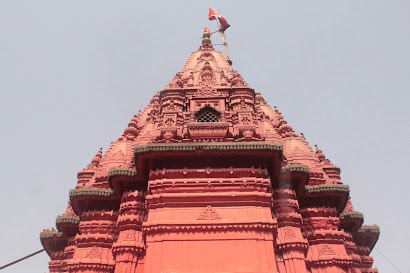
Durga Mandir

Shri Vishwanath Temple is situated inside Benaras Hindu University. The temple was built by the Birla family and was completed in 1966. The temple’s tower is 77 meters high, and is made largely of marble.

Shri Vishwanath Temple

Bharat Kala Bhawan is a museum inside the Benaras Hindu University campus. The museum moved to its present location in 1962. The artefacts on display include Buddhist and Hindu sculptures, paintings, Miniature paintings from the Mughal era, textiles, pottery, jewellery and ivory items.

Alice Boner's Creation, Bharat Kala Bhawan

Dancing Ganesha, Bharat Kala Bhavan

Shiva and Parvati, Bharat Kala Bhawan
Varanasi is certainly a fascinating city. It has that unique spiritual energy that is very uplifting. I was sad to see that the Ghats were not kept clean, and hygiene was a real concern. That really took away from what would have otherwise been an amazing experience. However, from what I've heard, in recent years, there have been huge efforts to clean up the Ghats and the River Ganga. With these enhanced steps, Varanasi is undoubtedly a place not to be missed by pilgrims, by travelers interested in temple architecture, and by visitors who are interested in Hinduism and the spiritual side of India.

Monday, July 13, 2020

My Visual Travel Experience: Napa, California

My wife and I spent a month in the western part of the USA in 2011 after our marriage. We spent time in Hawaii, San Francisco, Carmel, Napa, Fresno, Yosemite National Park, Las Vegas and Grand Canyon. We rented a car and drove to Napa, which lies about 80 km north of San Francisco. We enjoyed our tours of some of Napa's plush wineries. We got to taste many varieties of wine. Though we are not wine aficionados, we still had a great time tasting the delicious wines. The wineries were also beautiful and well worth seeing.

The town of Napa is situated in the American state of California. The town has a population of a little over 75,000 and is the second largest town in California’s wine growing region after Santa Rosa. Napa was incorporated as a city in 1872.

The first exploration of the area dates back to 1823. It was led by Padre Jose Altimira, the founder of Mission San Francisco Solano. The region was inhabited by Native American Indians back then. Many were converted to Christianity. Most others were driven out. In 1850, tensions between white settlers and Native American Indians resulted in many of the latter being killed. By 1870, the population consisted largely of white settlers.

Napa grew significantly in the California Gold Rush of the late 1850s. Agriculture and wine making became popular towards the turn of the century. Industries, commercial activities and the retail sector also expanded. Napa also developed one of the largest red light districts for a town of its size. Premium wine growing became popular in the 1960s, and today the region around Napa, known as Napa Valley, produces some of the world’s most premium varieties of wine.
Signage at the entrance to Napa Valley
Castle Winery, formally known as Castello di Amorosa, is a castle and winery. It opened in 2007. It was the brainchild of Dario Sattui, a 4th generation winemaker. The winery is on 171 acres of land. The castle has 107 rooms over 8 floors. The castle has a moat, a drawbridge, a courtyard, a torture chamber, a chapel, a knights’ chamber and a great hall.  Castle Winery produces 16,000 cases per year. Tours are allowed, as is wine tasting. 
Castle, Castle Winery
Chapel Interior, Castle Winery
Knights' Hall, Castle Winery
Vineyards, Castle Winery
The Entrance Gate, Castle Winery
Sterling Vineyards are spread over 1,200 acres of land. They produce 400,000 cases per annum. Visitors have to take cable cars from the entrance to the main villa and distillery. The white plastered villa looks like buildings in Mykonos, Greece. Production began in 1969.
Villa, Sterling Vineyards
View from the Terrace, Sterling Vineyards
Barrel, Sterling Vineyards
Hagafen Cellars is a winery that opened in 1979. It is California’s first kosher winery.  The winery makes 8,000 cases per annum. Hagafen specializes in Cabernet Sauvignon. Hagafen wines  cater to the top end of the market, and they have been served at the White House on many occasions.  
Overview, Hagafen Cellars
Barrel, Hagafen Cellars
Wine Tasting Room, Hagafen Cellars
Vineyards, Hagafen Cellars
First Presbytarian Church was built in 1874 in Neo Gothic style. It has an imposing steeple. The church was damaged in a 2014 earthquake, but was subsequently restored.
First Presbytarian Church
Interior, First Presbytarian Church
Napa was a charming place. The beautiful vineyards, the wine tasting experience, and the magnificent Medieval Europe inspired castle of Castle Winery were the highlights for me. My wife and I are both fans of dessert wine, and we got to taste some delicious dessert wine there. We have now managed to go to several wine growing areas in the world - Napa Valley in California, Duoro Valley in Portugal, and Yarra Valley in Melbourne. The area around Bordeux in France is still pending, as is the area around Nashik in India. All in all, it was a great outing from San Francisco!