Friday, April 24, 2020

My Visual Travel Experience: Sintra, Portugal

In 2012, my wife and I spent almost 2 weeks in Portugal. We traveled extensively, and we spent time in and around Lisbon in the centre of the country, in and around Porto to the north of the country, and in the Algarve to the south of the country. The wonderful trip came to an abrupt end when our passports and other valuables were stolen in a train in Lisbon. Despite that huge set-back which really shook us up, we look back at our trip with otherwise fond memories. The town of Sintra, on the outskirts of Lisbon, was one of the trip's highlights. We spent a pleasant day exploring this beautiful town.

The small town of Sintra lies about 30 km west of the Portugese capital Lisbon, and has a population of about 26,000. The town got its UNESCO World Heritage Site status in 1995, thanks largely to the presence of the striking National Palace of Sintra and the Pena National Palace, famed for its unique, eclectic architectural style. Sintra is one of the wealthiest towns in Portugal and is home to a large number of expat communities. It is known for its luxurious villas, its high standard of living, its fine dining options, and its expensive real estate.  
National Palace of Sintra
Sintra had a Roman presence from the 2nd century BC to the 5th century AD. The town then had a Moorish occupation that lasted for a few centuries. In the 11th century AD, the King of Leon, Alfonso VI, took control of Sintra. In 1109, Count Henry conquered the Castle of Sintra. Afonso Henriques, who took over Lisbon in 1147, established the Church of Sao Pedro de Canaferrim inside the Castle of Sintra. Till the end of the 19th century, Sintra was the favourite summer retreat of the Portugese royal family, first in the National Palace, and subsequently in the Pena Palace.

The Moorish Castle dates back to the 8th century and stands on a hill rising above the town. The castle was conquered by Afonso Henriques in 1147. The complex has a ruined chapel and a Moorish cistern. The walls of the castle can be seen from the town below.
The Moorish Castle
View of the Moorish Castle from the town centre

The Moorish Castle, seen from above
National Palace of Sintra was built in the late 14th century by Joao I. It became the summer retreat for the royal family, and continued to be till the 1880s. In the early 16th century, additions were made by Manuel I in the Moorish style. Two large conical chimneys rising above the kitchen are a striking feature of the palace. The palace became a national monument in 1910.
View of the National Palace of Sintra
Ceiling of Blazons Hall, National Palace of Sintra
Bed Chamber of King Sebastian, National Palace of Sintra
The Swan Hall at National Palace of Sintra is the former banqueting hall. The ceiling was painted in the 15th century, and has octagonal panels decorated with swans.
The Swan Hall, National Palace of Sintra
The Kitchen at National Palace of Sintra has utensils that were used to make royal banquets. The most striking feature of the kitchen are the two large chimneys, that can be seen from outside.
Kitchen, National Palace of Sintra
The Magpie Room is one of the highlights of National Palace of Sintra, and its ceiling has paintings of magpies, as a reference to the idle gossip of the court women.
Magpie Room, National Palace
Pena National Palace stands at one of the highest peaks around Sintra. It was built in the mid 19th century for King Consort Ferdinand II, the husband of Queen Maria II, in an assortment of architectural styles. The highlights include the brightly coloured clock-tower, the Triton Arch (with the sculpture of the sea monster), the Arab Room (with its splendid frescoes), the Ballroom (with its stained glass windows), and Manuel II’s bedroom (the bedroom of the last king of Portugal).
Pena National Palace
Triton Arch, Pena National Palace
Clock Tower, Pena National Palace
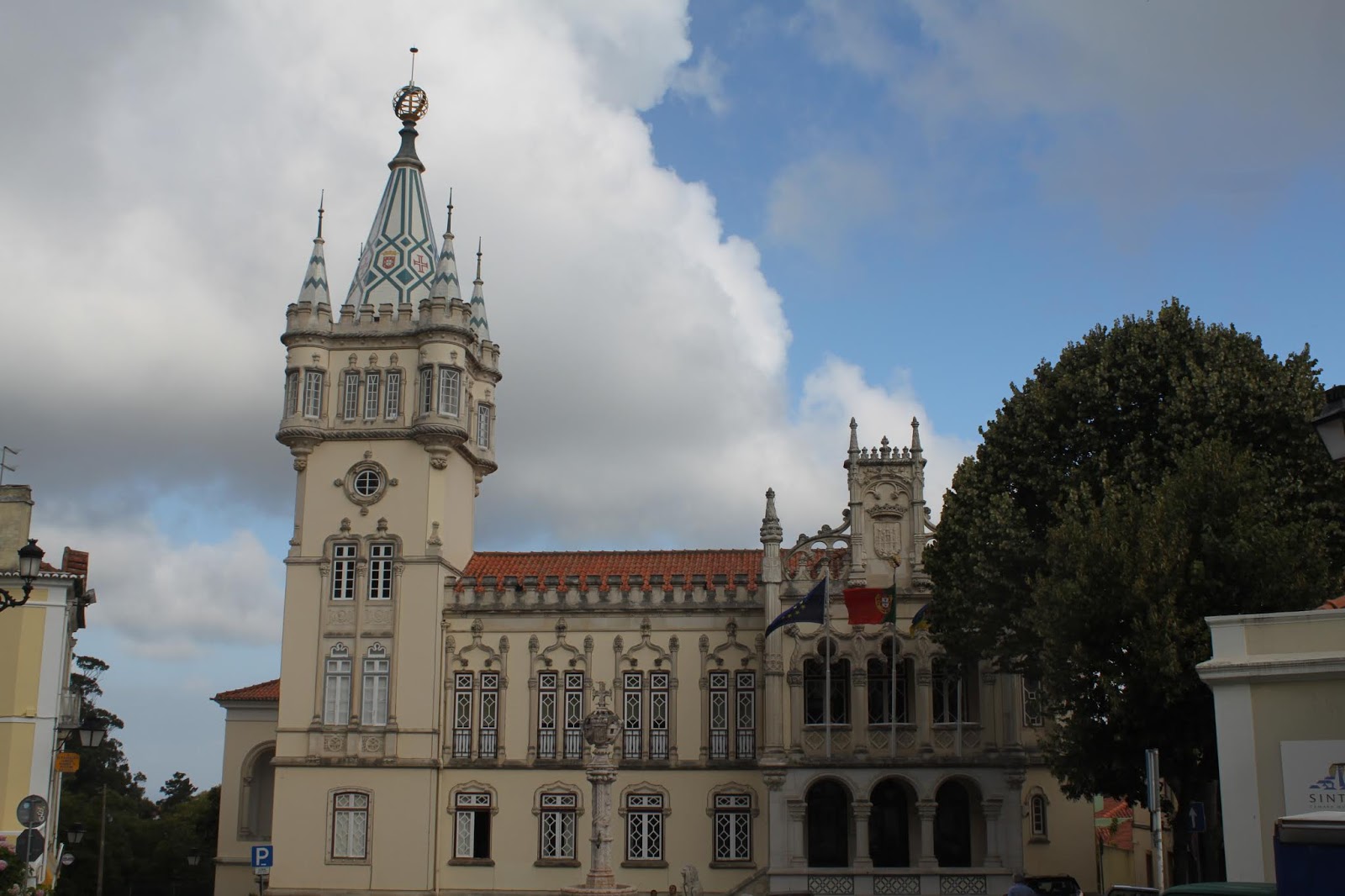
The Municipal Building, or Town Hall, houses the local administration, and is one of the most stunning buildings in the old town, with its remarkable tower, glazed with white and green tiles. The building was completed in 1910, and looks like it was inspired by the Disney Castle.
Municipal Building
The Clock Tower is a baroque structure in the heart of town, near the Post Office. The white coloured clock tower rises above boldly colourful buildings all around it.
Clock Tower
For me, the magnificent architecture and the beautiful hilly surroundings were the biggest highlights of Sintra. Its proximity to Lisbon made the trip convenient, as the train ride took just over half an hour. If you are in Lisbon, do make the effort and visit this stunning little town that offers so much by way of history and architecture.

Monday, April 20, 2020

My Visual Travel Experience: Sharjah

In 2000, I spent several days in the UAE. I stayed with my cousin Dilip, his wife Shobha, and their children Lavanya and Vidyut. They stayed in Sharjah back then. I spent most of my time seeing the sights of neighbouring Dubai, but I also got a flavour of Sharjah. I liked whatever little I saw, but I had one slightly avoidable experience - I remember exploring the Central Souk and admiring its beautiful architecture, when a policeman accosted me, asked me what I was doing, and told me not to loiter around! I was in a market - I wasn't in a high security zone, so that unnecessary episode left me a little shaken.

Then in 2016, I spent a week in the UAE. I again stayed with Dilip and Shobha. The kids had grown up and moved out of the country by then. Dilip and Shobha had moved from Sharjah to Dubai. I spent most of my time in Dubai - it was like seeing an entirely new city because it had transformed beyond recognition, with its glitzy new skyscrapers, malls and other attractions. The perfect hosts that they were, on my request, Dilip and Shobha did take me to Sharjah for a day. Unfortunately, it was a Friday and most things in the city were shut that day, because Sharjah is a conservative Islamic city, and most places are shut on Fridays. I still got to see most of the city's highlights from outside, and I also managed to spend time in the reputed Natural History Museum, which was open that day.

Sharjah is the third largest city in the UAE after Dubai and Abu Dhabi, and has a population of over 800,000 (2015). It is the capital of the emirate with the same name, which is one of the seven emirates that constitute the United Arab Emirates. The Emirate of Sharjah has a population of 1.5 million. The city of Sharjah lies barely 30 km north-east of the city of Dubai. Both cities have been developed along the Persian Gulf, just like Abu Dhabi, which lies about 140 km south-west of Dubai.

In the early 18th century, the Qawasim clan made Sharjah their base. In 1820, Sheikh Sultan signed a treaty with the British to keep the Turks out. In 1971, Sharjah became part of the United Arab Emirates, along with five other emirates, namely Dubai, Abu Dhabi, Ajman, Umm Al Quwain and Fujairah. The seventh emirate, Ras Al Khaimah, joined the UAE the following year. 

Sharjah is the cultural capital of the UAE. Sale and consumption of alcohol are prohibited in the emirate, without a license. Despite its proximity to Dubai, Sharjah is a lot more conservative than its larger, more cosmopolitan neighbour. Sharjah is known for its splendid Islamic architecture, its mosques, its souks, its large malls, its museums and its university.

Quran Roundabout is a large roundabout that has a Quran Sculpture in the centre. It dates back to 1987. It originally had a large flame, but that was removed out of safety concerns. Around the circular park in the centre, there are grand building like the Culture Palace, Sharjah Library, Al Emem Ahmad Bin Hanbal and Sharjah Information and E Government Centre.
Culture Palace, Quran Roundabout
Quran Sculpture
Sharjah Library
El Emem Ahmad Bin Hanbal
Sharjah Information and  E Commerce Centre
King Faisal Mosque was completed in 1987. It is named after King Faisal of Saudi Arabia. It was the city’s largest mosque until Sharjah Mosque came up in 2019. The mosque has two minarets that are 70 meters high. The mosque can take up to 16,000 worshipers.
King Faisal Mosque
Al Noor Mosque is located is located at the Corniche. It has been influenced by the Turkish style of mosques. It is one of Sharjah’s few mosques open to the public. In 2014, the mosque set a record for having the world’s largest wooden charity box for the Ramzan donation campaign.
Al Noor Mosque
The Corniche is a strip of land around Khalid Lake that has residential complexes, parks, supermarkets and restaurants.
The Corniche, with the Radisson Hotel and Bin Darwish Mosque
Palm Trees around the Corniche
The Central Souk, also called the Blue Souk, is an important shopping centre and landmark. The market was completed in 1978. It was built by British architects, but under the guidance of the ruler of Sharjah. The market has two large buildings connected by bridges. The market has wind-tunnels and blue tiles. There are over 600 shops, selling items like jewellery, souvenirs, electronics, clothes and household goods.
Central Souk
Central Souk with fountain
Emirates Sail Tower opened in 2008. The building has a height of 157 meters, and has 36 floors. It has high end apartments .
Emirates Sail Tower
Museum of Islamic Civilization opened in 2008. It has more than 5,000 objects from the Islamic world. The collections include ancient Korans, calligraphy, ceramics, manuscripts, coins and metal works. Located on the Corniche Street, the museum is an upgrade of the Islamic Museum that opened in 1996 in a different building.
Museum of Islamic Civilization
Sharjah University City is located near Sharjah International Airport. The well known American University of Sharjah is a part of it. The sprawling campus is known for its grand buildings, in Islamic architectural style.
American University of Sharjah,
Sharjah University City
Library,
Sharjah University City
The Natural History Museum has a large collection of stuffed animals and birds from the region. It also has models of dinosaurs. The museum has a collection of live reptiles (including snakes and tortoises) and fish. The adjoining Arabian Wildlife Centre has a large number of Arabian animals (like the oryx, mountain goats and antelopes) and birds (like the flamingo), which can be observed through a glass panel in the museum’s cafeteria.
Dinosaur Skeleton, Natural History Museum
Fossilized Fish, Natural History Museum
Mountain Goat, Natural History Museum
Eagle, Natural History Museum
Owl, Natural History Museum
Sharjah may not have the glitz and glamour of Dubai, it may have less attractions than Dubai, but if you're going to be in Dubai for a few days, Sharjah certainly warrants a trip. The two cities practically touch each other, and what makes the trip especially worthwhile is the marvelous Islamic architecture that one gets to see.

Thursday, April 16, 2020

My Visual Travel Experience: Ho Chi Minh City

In 2015, I spent a day in Vietnam's largest city, Ho Chi Minh City. It was totally unplanned, and I managed to do it without a visa!! I was traveling from Siem Reap (Cambodia) to Hong Kong, and I had to change planes in Ho Chi Minh City. My flight from Siem Reap to Ho Chi Minh City was a couple of hours late, so I missed my connecting flight, as did three others. It was mid morning, and the next flight to Hong Kong wasn't till the evening, which meant we had the full day. I got excited and made inquiries about whether we could go into town, so that I could spend the day exploring its main sites. There was disappointment in store, because I was told one had to apply for a visa at least 72 hours in advance.

A little later, Vietnam Airlines approached us and said we had the option of either waiting in the airport lounge, or they could take us to a hotel in town, where we would be given rooms, and we could have lunch at the restaurant, but they would be taking our passports away till the evening because we weren't allowed to leave the hotel. We chose this second option. So we were put into a bus and taken to a four star hotel in the city. We were told to assemble in the hotel's lobby at a certain time in the evening, and we would then be given our passports and taken back to the airport.

I went to my room and freshened up. I grabbed an early lunch at the hotel's restaurant. I can never forget my lunch experience. Those days, I was vegetarian. I had grown up as a non vegetarian, but two years earlier, after my father passed away, I had turned vegetarian. There was a wide buffet spread at the restaurant, with some 50 items on offer. I went around and checked out the spread, and to my utter horror, I found that not a single item was vegetarian! Even the salad had sea-food. I would have practically starved that day, but I went back on my resolve and I ate non vegetarian food again after a gap of close to two years, because I didn't want to survive on just plain bread and fruit!

After lunch, I said to myself that I had an opportunity to see the main sites of Ho Chi Minh City. Yes, we had been told that we couldn't leave the hotel, but there was no security, and as long as I was back in the hotel lobby at the designated time, I didn't see what harm there was. I checked with my fellow travelers, but they had no such desires, and weren't comfortable leaving the hotel when they had been told not to. Feeling fairly nervous because I was technically breaking a rule, I stepped out of the hotel. I found a motorcycle taxi, I paid the driver USD 10, and I told him to take me to the main sites of the city and bring my back to the hotel by the designated hour. He couldn't understand a word of English, but I had a book on Vietnam with me, so I showed him one photograph after another, and that's how he took me to the main sites of the city!

Ho Chi Minh City, formerly known as Saigon, is Vietnam’s largest city and commercial capital, with a population of 8.9 million (as of 2019). Located in the southeastern part of the country, it lies along the Saigon River. From 1955 to 1975, it was the capital of the Republic of Vietnam, also known as South Vietnam. The unified country's capital is Hanoi, a marginally smaller city with a population of 8 million.

There was a Buddhist temple in the region in the 4th century AD. In the 11th century, the Champas formed a settlement. The Cham Empire was invaded by the Khmer people, who lived there for centuries. In the early 17th century, Vietnamese settlers took over from the Khmers. In 1698, Nguyen Huu Cahn took over the administration of the region and cut it off from Cambodia. The area was colonized by France and Spain in 1859, and it was handed over to France in 1862 through the Treaty of Saigon. French influence is evident in the city’s architecture even today. The Viet Minh proclaimed independence of Vietnam in 1945. The Viet Minh were led by Ho Chi Minh.

Bao Dai, the former Emperor, made Saigon the capital of the State of Vietnam in 1949. In 1954, the Geneva Agreement partitioned Vietnam. The Viet Minh under Ho Chi Minh got control of northern Vietnam, and Saigon went to South Vietnam. South Vietnam was a capitalist state, and North Vietnam was communist. The two fought the Vietnam War, with South Vietnam supported by the USA, and North Vietnam backed by USSR and China. In 1975, Saigon fell to North Vietnam. In 1976, the unified communist Socialist Republic of Vietnam was established. Saigon was renamed Ho Chi Minh City, after the communist leader who died in 1969. Hanoi, in North Vietnam, became the capital of the unified nation.

Notre Dame Cathedral was built by the French and completed in 1880. It was initially called Church of Saigon. The large church has two bell towers that stand  at a height of 58 meters. The original building materials for the church were all brought from France. The church is known for its exquisite stain glass panels.
Notre Dame Cathedral
Statue of Our Lady,
Notre Dame Cathedral
Notre Dame Cathedral with the
Statue of Our Lady
Central Post Office lies next to the Notre Dame Cathedral. It was completed in 1891 and has Gothic, Renaissance and French architectural styles. 
Central Post Office
Interior, Central Post Office
Ho Chi Minh's Portrait, Central Post Office
City Hall was completed in 1908 in the French colonial style of architecture. It is not open to the public, but is a popular tourist attraction because of its splendid architecture. Outside City Hall, there is a statue of Ho Chi Minh.
City Hall
Saigon Opera House was built in the French architectural style in 1897. It has 500 seats. After 1956, it was used as the Lower House Assembly. It was used as a theatre again only after 1975. It is a smaller counterpart of the Hanoi Opera House.
Saigon Opera House
Facade, Saigon Opera House
Pillars, Saigon Opera House
Bas Relief, Saigon Opera House
Reunification Palace is on the site of the former Norodom Palace, completed in 1870 and named after the King of Cambodia. It was the Governor’s Palace from 1871 to 1888 for the French Governor of Cochinchina. From 1888 to 1945, it was the palace and office of the Governors General of French Indochina. It was the home and office of the President of South Vietnam during the Vietnam War. A North Vietnamese tank crashed through its gates at the end of the Vietnam War. 
Reunification Palace
Close-up, Reunification Palace
Ben Thahn Market is a famous market, popular with locals and tourists. The current structure dates back to 1912, and it underwent major renovations in 1985. The large market has close to 1,500 booths. 
Ben Thahn Market
Interior, Ben Thahn Market
There are four gateways to the market. The southern side has garments, shoes, jewellery and cosmetics. The northern side has fruits, fish, poultry and street food. The eastern side has packaged food items. The western side has arts, ceramics and souvenirs. 
Flowers, Ben Thahn Market
Masks, Ben Thahn Market
Souvenirs, Ben Thahn Market
Lamps, Ben Thahn Market
Bitexco Financial Tower is a 262 meter (861 ft) tall skyscraper with 68 floors, and it was completed in 2010. At that time, it was the highest building in Vietnam. The tower is owned by the Bitexco Group, which is into real estate. The tower has offices, retail outlets, restaurants and entertainment, and it also has a helipad on the 52nd floor. On the 49th floor, there is an observation deck for the public.
Bitexco Financial Tower
I certainly didn't have enough time to do justice to the city, but those few hours gave me a flavour of Ho Chi Minh City, as I managed to see several of the main attractions! I do hope to return one day, this time with a visa, and spend a few days exploring the city in more detail!